
What Credit Score Do You Need for an Auto Loan?

Carfixcredit | Updated April 2026 | 7 min read
This is one of the most searched questions in auto financing and the honest answer is that there isn’t a single number that applies to everyone.
Different lenders have different thresholds. Different loan types have different requirements. And your credit score is only one piece of what lenders actually look at when they decide whether to approve you and at what rate.
What this guide will do is give you a clear, realistic picture of what different score ranges mean for your auto loan, what to expect at each level, and what your options are regardless of where your score sits right now.
The Short Answer
There is no universal minimum credit score required to get an auto loan.
Some lenders won’t approve buyers below 660. Others specialize in buyers below 500. Buy here pay here dealerships often don’t use credit scores at all.
The real question isn’t whether you can get approved. It’s what your score means for the rate you’ll pay and which lenders are the right ones to approach.
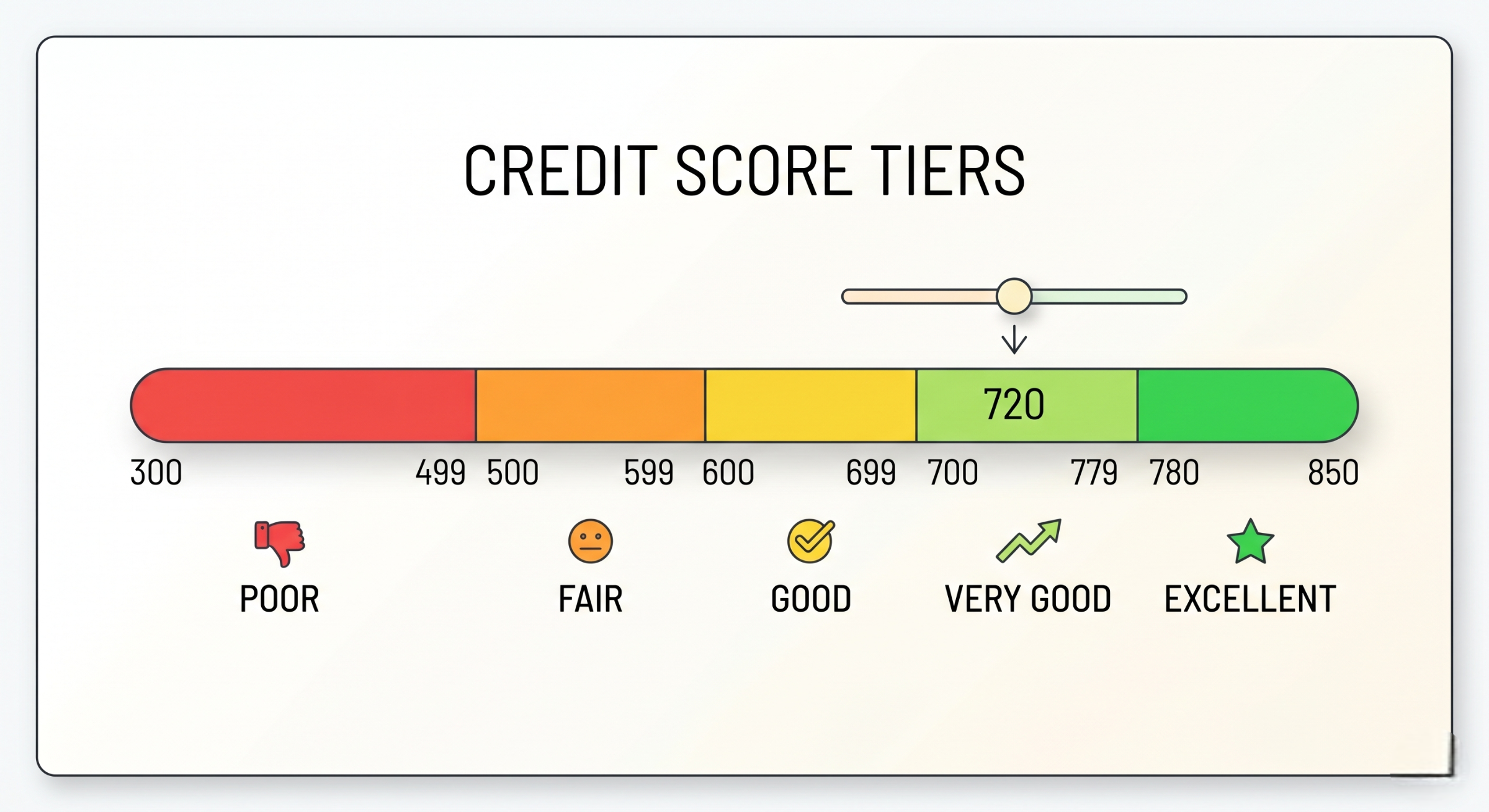
What Different Score Ranges Mean for Auto Financing
Exceptional Credit: 800 and Above
If your score is here, you’re in the best possible position. Lenders compete for borrowers at this level and the rates reflect that. You’ll have access to the lowest APRs available, the widest range of lenders, and the most flexibility on loan terms and vehicle type.
Your main job at this level is to shop around and choose the best offer rather than accepting the first one.
Very Good Credit: 740 to 799
Still excellent territory. The difference between this range and exceptional is usually small in dollar terms. You’ll see competitive rates across most lenders and have access to virtually all standard auto loan products.
Good Credit: 670 to 739
Solid credit that qualifies you for most standard auto loans at reasonable rates. Some premium rate offers may sit just out of reach but you’re in good shape overall. Shopping across multiple lenders is worth doing at this level because the variation in offers starts to become meaningful.
Fair Credit: 580 to 669
This is where rates start climbing noticeably. You’re still very financeable through many lenders but the cost of borrowing goes up. The gap between the best and worst offers available to you is wider here than for buyers in higher tiers. Shopping around matters more at this level, not less.
Poor Credit: 500 to 579
Subprime territory. Traditional banks and credit unions become less accessible options. Specialist lenders who work specifically with challenged credit become your primary path. Rates are higher but approval is genuinely possible with the right lender. Finding auto loan approval with poor credit is more realistic than most buyers in this range expect.
Very Poor Credit: 300 to 499
The most limited options but not zero options. Buy here pay here dealerships and specialty subprime lenders are the most accessible routes. A co-signer with strong credit opens additional possibilities. This range is difficult but it’s important to know that scores here can and do improve with consistent effort over time.
No Credit History
Having no credit history is a different situation from having bad credit. There’s no negative information working against you but there’s also no positive history for lenders to evaluate. First-time buyer programs at credit unions, co-signers, and lenders who specialize in thin-file applicants are the most practical starting points.
What Lenders Actually Look At Beyond the Score
Your credit score opens the conversation. It doesn’t end it.
Lenders who work with a range of credit profiles look at several other factors alongside the score. Understanding these helps you know where your application is strongest and where you might need to compensate.
Income and employment stability
A consistent, verifiable income tells the lender the monthly payment is manageable. Stable employment history, even if it’s relatively recent, works in your favor. Self-employed buyers can qualify but typically need more documentation to verify income.
Debt-to-income ratio
This is the percentage of your monthly income already going toward existing debt payments. A lower ratio gives lenders more confidence that adding a car payment won’t stretch you past a manageable limit. A high ratio is a flag regardless of your credit score.
Down payment
Money down reduces the lender’s risk immediately. It means a smaller loan, lower monthly payments, and less chance of going underwater on the vehicle. For buyers with lower scores, coming in with 0 or little down is possible but even a modest amount can meaningfully improve your approval odds and the terms offered.
The vehicle itself
Lenders care about what they’re financing. Older vehicles, high mileage, or makes with poor reliability histories can limit what lenders will approve. Keeping your vehicle choice reasonable relative to your credit profile makes the process smoother.
How Your Score Affects the Rate You Pay
This is where the real money is.
The difference in rate between a buyer with excellent credit and one with poor credit on the same vehicle can be 12 to 15 percentage points or more. Over a multi-year loan, that translates to thousands of dollars in additional interest paid.
Here’s a concrete example using a $20,000 loan over 60 months.
At 5.5 percent, the total interest paid over the loan is roughly $2,950.
At 12 percent, the total interest climbs to approximately $6,680.
At 18 percent, the total interest reaches around $10,400.
That’s a spread of nearly $7,500 in total cost on the same $20,000 vehicle depending purely on the rate. The car doesn’t change. The financing is what changes everything.
Understanding this relationship is why improving your credit before you apply, even by a modest amount, is worth the effort. Every tier you move up changes the rate conversation.
What to Do if Your Score Isn’t Where You Want It
Sometimes you need a car before your credit is where you’d like it to be. That’s a real situation and it has a real solution.
Get into a vehicle through the best financing available right now. Make every payment on time. Watch your score improve over the next 12 to 18 months. Then revisit refinancing once your credit has moved into a better range.
That’s not settling. That’s a practical plan that gets you where you need to go, builds your credit in the process, and sets you up for better terms the next time around.
A few specific steps worth taking before you apply regardless of where your score sits.
Check your credit report for errors first. Mistakes on credit reports are more common than most people realize. A payment incorrectly reported as late or an account that doesn’t belong to you can drag your score down without reflecting your actual behavior. Dispute any errors before you apply anywhere. It’s free and the correction can move your score meaningfully.
Pay down credit card balances where you can. Reducing your credit utilization ratio has one of the fastest effects on your score of any action available. Even getting one card from 80 percent utilization down to 40 percent can produce a visible improvement within a billing cycle or two.
Check the timing of your applications. If your score is close to the next tier up, waiting a couple of months while cleaning up your report and reducing balances can save you real money over the life of the loan.
Should You Wait or Apply Now?
This is a question a lot of buyers sit with and the answer depends on your specific situation.
If you need a vehicle for work and can’t wait, apply now with the right lenders for your current score. Get into a vehicle, make your payments consistently, and refinance when your credit improves. The higher rate costs you something in the short term. The vehicle and the credit building that comes with consistent payments are worth it.
If you can wait six to twelve months and your score is close to a meaningful threshold, the improvement in rate can genuinely justify the wait. Moving from a 620 to a 670 changes your lender options and your rate tier noticeably.
If your score is already in good shape and you’re waiting for perfect, stop waiting. The difference between very good and exceptional credit is usually small enough in dollar terms that it doesn’t justify putting off a purchase you need to make.
A Note on Rate Shopping
Whatever your score, shop across multiple lenders before you commit to anything.
The same credit profile produces different rate offers from different lenders. Some lenders specialize in specific credit tiers and offer more competitive terms within those tiers than general lenders do.
The good news is that rate shopping for an auto loan within a short window doesn’t hurt your credit the way applying for multiple credit cards would. The credit bureaus generally treat multiple auto loan inquiries within 14 to 45 days as a single inquiry for scoring purposes.
Comparing auto loan rates across multiple lenders before you accept any offer is one of the simplest things you can do to reduce what the vehicle actually costs you over time.
The Bottom Line
There’s no magic number that opens every door. But there are clear ranges that tell you what to expect, which lenders to approach, and what your rate is likely to look like before you walk in anywhere.
Strong credit gives you options and leverage. Fair or poor credit gives you fewer options at a higher cost, but options nonetheless. No credit gives you a starting point.
Wherever your score sits right now, the most useful thing you can do is know it, understand what it means, and approach the right lenders for your actual situation rather than wasting applications on lenders who won’t work with your profile.
How Carfixcredit Works Across All Credit Profiles
Whether your score is strong, challenged, or somewhere you’d rather it wasn’t, Carfixcredit connects buyers across the United States with lenders built for real credit situations.
The process takes about two minutes and checking what you qualify for won’t affect your credit score.
If you’ve been avoiding this conversation because you weren’t sure what to expect, finding out is always better than guessing.