
Zero Down Car Loans: Pros, Cons, and the Hidden Costs Most Buyers Miss
TL;DR — Quick Summary
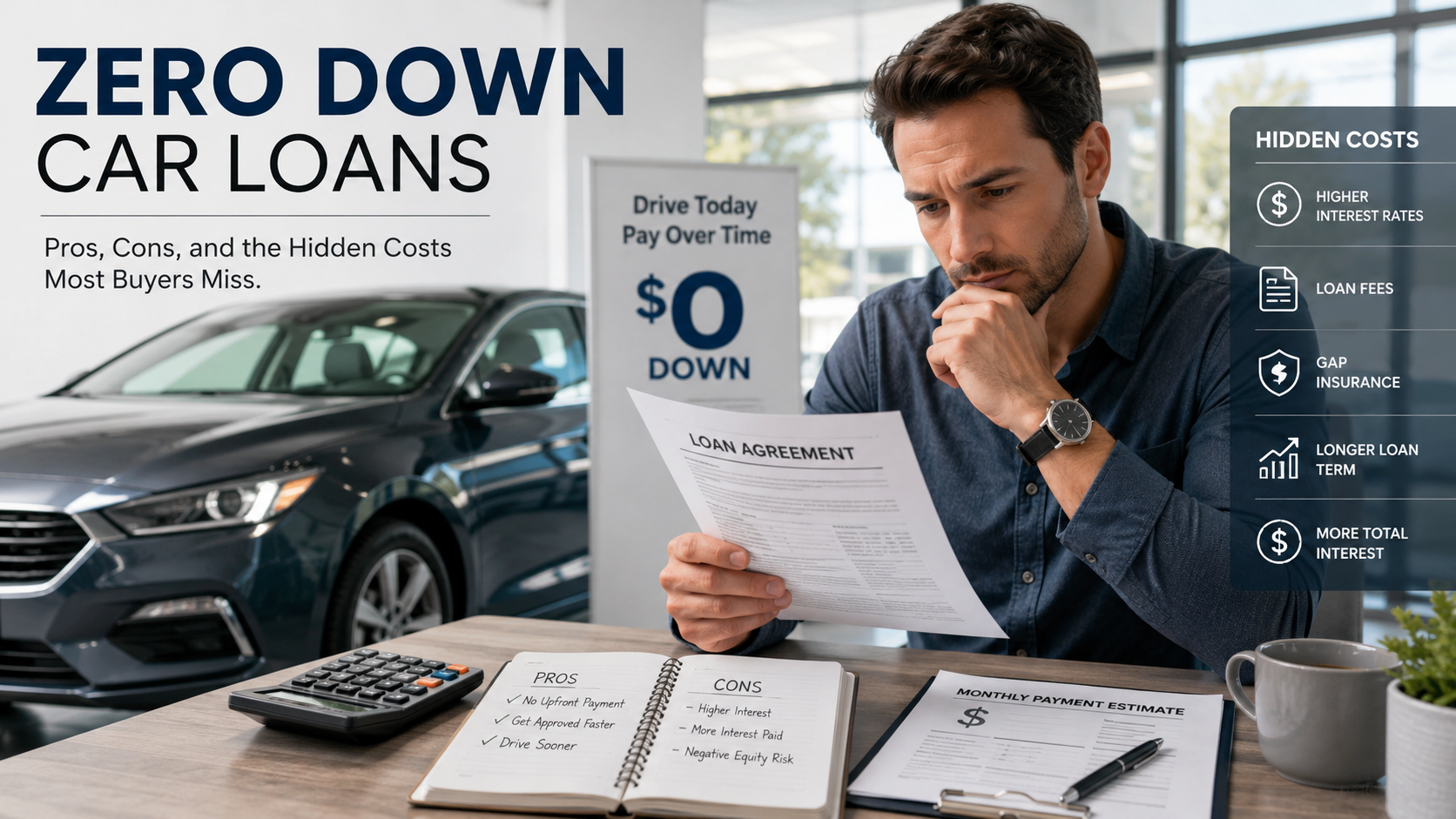
- Zero down car loans finance 100% of the vehicle price, so you drive away without paying anything upfront — but your monthly payment runs roughly 10–15% higher than a loan with 10% down.
- The biggest hidden cost is negative equity: a $0 down borrower can owe more than the car is worth for the first 18–24 months of the loan.
- Lenders typically reserve $0 down approval for borrowers with steady income, manageable debt-to-income, and proof of residence — not just a credit score threshold.
- CarFix Credit offers $0 down financing options across all 50 US states with loan amounts from $5,000 to $75,000 and terms from 12 to 96 months.
- Skipping the down payment makes sense when you’d rather keep cash for insurance, registration, and an emergency fund — not because you can’t budget for one.
A 2024 Edmunds report found that nearly one in five new-car buyers in the United States rolled some form of negative equity into their next loan — and the trend lines up with the rise of zero down car loans. The promise is simple: walk into a dealership, sign a few forms, and drive home the same day with nothing out of pocket. The math behind that promise is where things get complicated.
A zero down car loan finances 100% of the vehicle price, taxes, and fees with no upfront cash from you. That helps when you need a vehicle now and your savings are earmarked elsewhere. It hurts when the higher monthly payment, longer term, and depreciation curve start working against you in month three.
This guide breaks down exactly when a $0 down auto loan saves you money, when it costs you more, what hidden fees to watch for, and how to qualify even with credit challenges.
CARFIX CREDIT
Curious whether you’d qualify for a $0 down auto loan?
CarFix Credit lets you check your approval odds in a few minutes using a soft credit pull. It only takes a few minutes — no credit check required to start.
What a Zero Down Car Loan Actually Is
A zero down car loan is an auto loan structured to finance the vehicle’s full purchase price, including state sales tax, title, and registration fees, without requiring an upfront cash payment from the buyer. The lender funds 100% of the price, and your loan-to-value ratio at signing sits at — or slightly above — the vehicle’s actual market value.
Loan-to-value (LTV) ratio is the amount you’re borrowing divided by the value of the vehicle, expressed as a percentage. A traditional auto loan with a 10% down payment puts you at 90% LTV; a $0 down loan typically lands at 100–110% LTV once taxes and fees are rolled in.
Most lenders cap $0 down financing at a certain LTV ratio — often 115–125% for prime borrowers and tighter for subprime. CarFix Credit works with a network of lenders that allow flexible LTV structures for borrowers across all credit tiers, which is why understanding your car loan terms matters before you sign anything.
The Real Pros of $0 Down Financing
Zero down auto loans solve a specific problem: getting into a reliable vehicle when your cash position can’t absorb a four-figure down payment. The advantages are practical, not abstract.
- You keep your emergency fund intact. A $2,000–$4,000 down payment is also a $2,000–$4,000 cushion you no longer have if your transmission fails six months in.
- You can cover the real cost of vehicle ownership. Insurance binders, registration, sales tax, and the first tank of gas add up quickly. Keeping that cash on hand prevents a domino effect.
- You get into a vehicle faster. No saving period. If your current car is unreliable or you’ve just relocated for a job, that matters.
- You build payment history on a long-term loan. Auto loans are reported to all three major US credit bureaus, so consistent on-time payments rebuild credit even when the loan started with no down payment.
- You preserve flexibility for trade-ins. Some buyers prefer to apply their cash toward a larger trade-in negotiation rather than handing it to the lender.
“The average new car loan APR in the United States reached 7.18% in Q4 2024, while used auto loan APRs averaged 11.93% across credit tiers.” — Experian State of the Automotive Finance Market, Q4 2024
The Cons You Need to Weigh Honestly
A $0 down loan costs more in absolute dollars over the life of the loan than a financed purchase with money down — almost without exception. The math is straightforward: you’re borrowing more, paying interest on a larger principal, and often stretching the term to keep the monthly payment manageable.
On a $25,000 vehicle financed at 9% APR for 72 months, putting $2,500 down (10%) produces a monthly payment of about $406 and total interest of $6,748. The same vehicle with $0 down at the same rate and term produces a payment of around $451 — and total interest of about $7,498. That’s $750 in extra interest just to skip the down payment.
You also need to think about how your credit score affects your loan. Subprime borrowers (FICO under 620) face APRs that frequently exceed 13%, which compounds the cost of $0 down financing significantly. A borrower at 14% APR who skips a $3,000 down payment can end up paying an extra $1,500+ in interest over the life of a 72-month loan.
⚠️ Negative Equity Risk: A new vehicle loses 20–30% of its value in the first 12 months. With $0 down and taxes financed in, your loan balance can exceed the vehicle’s market value for 18–24 months. If the car is totaled or stolen during that window and you don’t carry gap insurance, you’ll owe your lender thousands more than the insurance payout.
The Hidden Costs Most Buyers Miss
The sticker math on zero down financing only tells half the story. The other half lives in line items most buyers don’t read carefully on the financing addendum.
- Higher APR for $0 down terms. Some lenders price zero down loans 0.5–1.5 percentage points above the same loan with a down payment because the LTV ratio is higher. The buyer is taking on more risk-adjusted exposure, and the lender prices it in.
- Mandatory gap insurance. Many $0 down loans require gap insurance — coverage that pays the difference between what you owe and what your car is worth if it’s totaled. Useful, but adds $20–$60 per month or a $400–$700 one-time charge.
- Dealer-financed taxes and fees. Sales tax (which varies from 0% in states like Oregon and Montana to over 7% in California and Tennessee), title fees, registration fees, and documentation fees all get rolled into the financed amount. You pay interest on every dollar of it.
- Longer terms to hit a target payment. The average new auto loan term in the United States reached 68 months in 2024, up from 60 months a decade ago. Stretching to 84 months on a $0 down loan lowers the payment but adds two more years of interest.
- Add-on products. Extended warranties, paint protection, tire-and-wheel coverage, and similar add-ons can pad the financed amount by $1,500–$3,500 if you don’t decline them at signing.
A useful exercise: use a free tool to estimate your monthly payment at $0 down and at 10% down before you walk into any dealership. The dollar difference over 60–72 months is usually larger than buyers expect.
CARFIX CREDIT
Over 183,000 Americans Have Been Approved Through CarFix Credit.
CarFix Credit offers $0 down financing options on loan amounts from $5,000 to $75,000, with terms from 12 to 96 months across all 50 US states. All credit types are welcome — including no credit, bad credit, and post-bankruptcy borrowers.
Who Actually Qualifies for $0 Down
Qualifying for a zero down auto loan depends less on a single credit score and more on the combination of income stability, debt-to-income ratio, and time at residence. Lenders use these together to estimate whether you can absorb the higher monthly payment that $0 down produces.
Prime borrowers (FICO 680+) typically need monthly income of $1,800–$2,000, at least 6 months at their current job, and a debt-to-income ratio under 45%. They’ll see APRs in the 6–9% range. Subprime borrowers (FICO 500–679) generally need stronger fundamentals — $2,000–$2,500 in monthly income, 12+ months on the job, and a DTI under 40% — and should expect APRs between 13% and 22% depending on credit tier.
A co-signer with strong credit can move a subprime borrower into approval territory that wouldn’t be available on their own application. If you’re considering this route, learn how the CarFix Credit process works before submitting — knowing what the underwriter looks at gives you a real advantage.
When Zero Down Actually Makes Sense
A $0 down auto loan is the right choice when keeping your cash on hand is more financially valuable than reducing your monthly payment. That’s true more often than personal finance blogs suggest — especially for Americans rebuilding from a credit event.
Zero down makes sense when you’re returning to work after a layoff and need a reliable car to keep the new paycheck flowing. It makes sense when you’re moving from a state with low sales tax to one like California or Tennessee where registration and tax costs at signing are substantial. It makes sense when your savings would otherwise be wiped out by the down payment, leaving you exposed to the first unexpected expense.
Zero down does not make sense when you have $3,000+ in savings beyond your emergency fund, are comfortable with a fixed monthly payment that fits well within budget, and want to minimize total interest paid. In that case, putting 10–20% down through CarFix Credit or any other lender reduces both your APR and your total cost of borrowing meaningfully.
How to Apply for a Zero Down Auto Loan the Smart Way
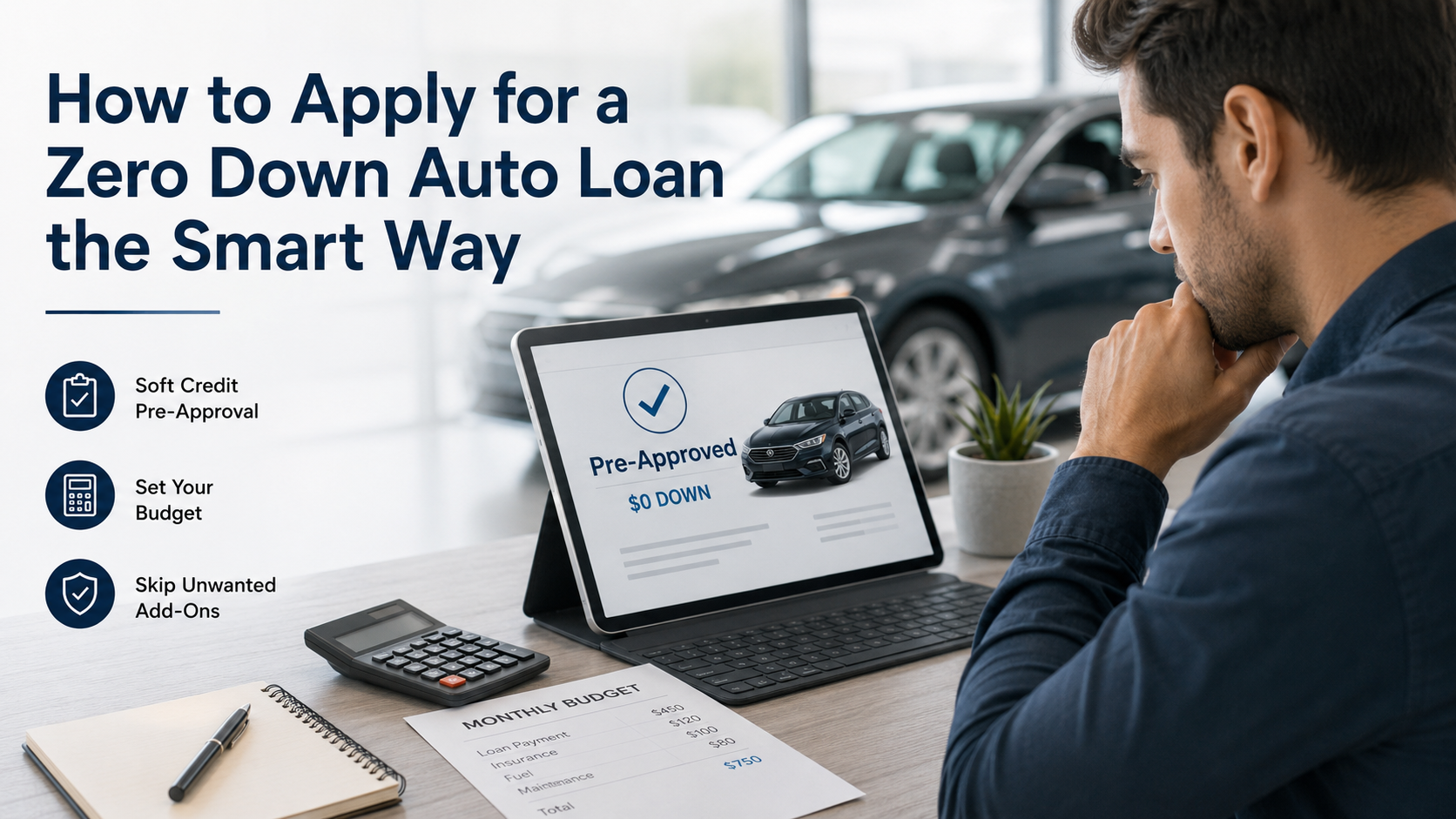
Applying for a $0 down auto loan starts with a soft credit pull pre-approval — not a hard inquiry at a dealer’s finance office. A soft credit pull shows you what you’d qualify for without affecting your credit score, while a hard pull at a dealership can shave 5–10 points off your FICO temporarily.
- Pre-approve online first. Get a real loan offer with terms, APR, and approved amount before you set foot on a lot.
- Calculate your true monthly cost. Include insurance, fuel, registration, and routine maintenance — not just the loan payment.
- Set a vehicle budget. A safe rule of thumb: total monthly car cost (loan + insurance + fuel) under 15% of gross monthly income.
- Decline unwanted add-ons. Politely refuse extended warranties, paint protection, and similar finance-office add-ons unless they genuinely fit your situation.
- Plan your first 90 days. On-time payments on your new loan will start lifting your credit score within 60–90 days, opening the door to refinancing at a lower rate.
For buyers ready to compare actual offers, you can explore more auto financing guides on credit repair, refinancing, and trade-in strategy before committing to a vehicle.
Frequently Asked Questions
Can I get a zero down car loan with bad credit?
Yes, you can get a zero down car loan with bad credit through CarFix Credit and other subprime-friendly lenders, though approval typically requires steady monthly income of at least $2,000, 12+ months at your current job, and a debt-to-income ratio under 40%. Expect an APR of 13–22% depending on your credit tier, and consider a co-signer to improve your terms if one is available.
How much more does a $0 down car loan cost over the life of the loan?
A $0 down car loan typically costs $700–$2,000 more in total interest than the same loan with a 10% down payment, depending on the vehicle price, APR, and term length. On a $25,000 vehicle financed at 9% APR over 72 months, skipping a $2,500 down payment adds roughly $750 in interest.
Does a zero down auto loan hurt my credit score?
A zero down auto loan does not hurt your credit score by itself — applying for any auto loan triggers a hard inquiry that can lower your score temporarily by 5–10 points, but consistent on-time payments build positive history that lifts your score over time. CarFix Credit uses a soft pull for pre-approval, which doesn’t affect your score at all.
What is negative equity on a $0 down car loan?
Negative equity occurs when you owe more on your auto loan than the vehicle is currently worth, which is common in the first 18–24 months of a $0 down loan because new cars depreciate 20–30% in the first year. Gap insurance protects you against this gap if the car is totaled before the loan balance catches up to the vehicle’s market value.
Do I need gap insurance for a zero down car loan?
Gap insurance is strongly recommended for any zero down auto loan and is required by some lenders, because financing 100% of the vehicle price plus taxes and fees puts your loan balance above the vehicle’s market value for the first 18–24 months. Without gap coverage, a total loss during that period means paying the difference out of pocket.
Can I refinance a $0 down auto loan later?
Yes, you can refinance a zero down auto loan once you’ve built positive payment history — typically after 6–12 months of on-time payments — and if your credit score has improved or your loan-to-value ratio has dropped below 100%. Refinancing can lower your APR by 2–5 percentage points if your credit has improved, reducing your monthly payment and total interest.
Get Pre-Approved for a $0 Down Auto Loan Today
CarFix Credit helps Americans across all 50 states get approved for auto financing — regardless of credit history. Loan amounts from $5,000 to $75,000, terms from 12 to 96 months, and approval decisions in minutes.
- ✅ All credit types welcome — including bad credit and bankruptcy
- ✅ $0 down financing options available
- ✅ No credit check to start the application
- ✅ Approval decisions in minutes, fully online
📍 Address: 3401 N. Miami Ave, Suite 230, Miami, FL 33127
🌐 Website: carfixcredit.com
🇺🇸 Coverage: All 50 US states — fully online application
Bad credit. No credit. Bankruptcy. CarFix Credit helps you get on the road regardless.