
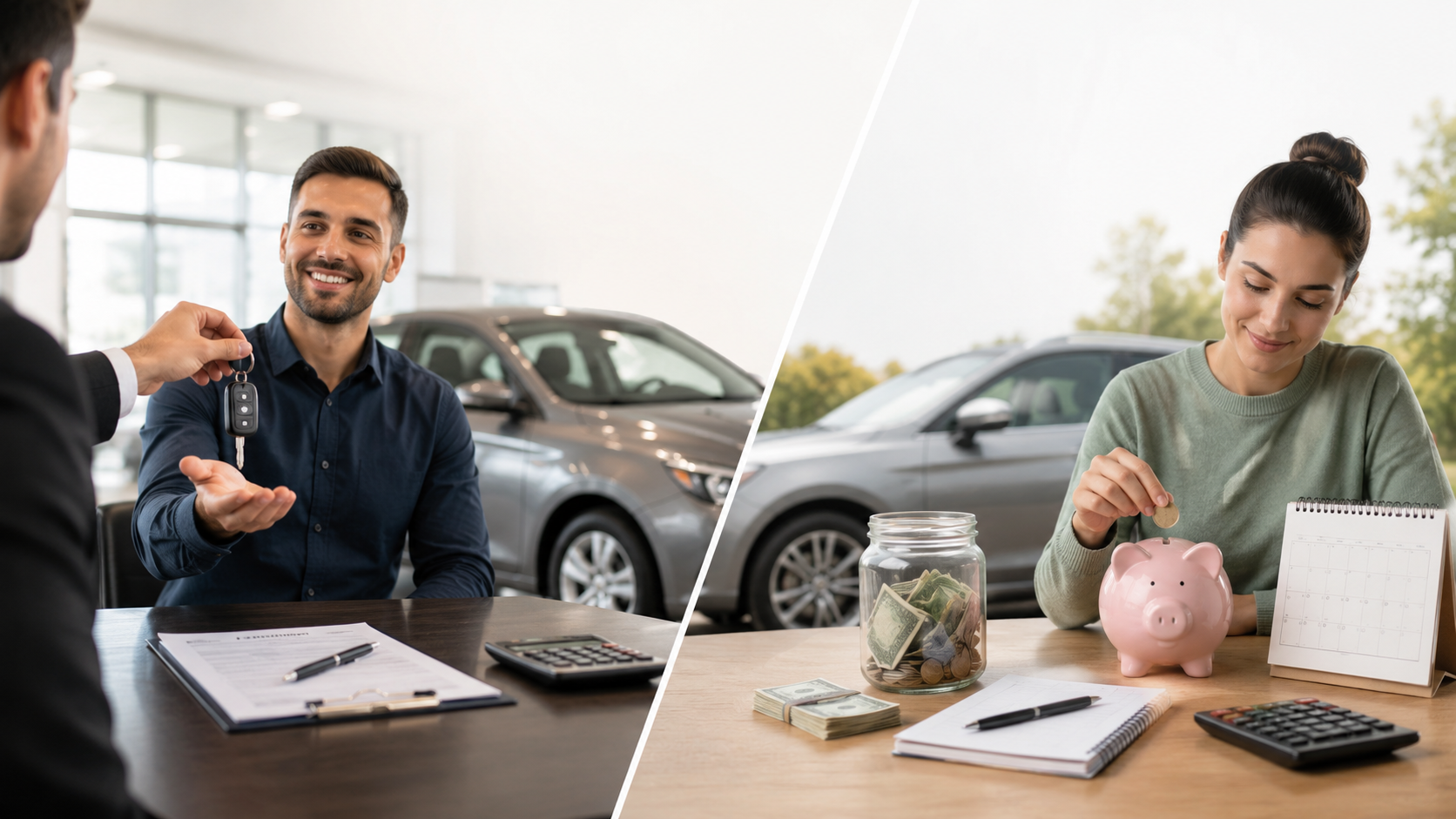
Zero Down vs. Saving a Down Payment: A True Cost Comparison
TL;DR — Quick Summary
- A $0 down auto loan on a $25,000 vehicle at 11% APR over 60 months costs roughly $7,635 in interest, while a 10% down loan ($22,500 financed) at the same rate costs about $6,872 — a difference of $763 over five years.
- Saving a 10% down payment at $200 per month takes 12–13 months, during which US new-vehicle prices rose an average of 2–3% per year and APRs can shift in either direction.
- Zero down beats saving when you need reliable transportation immediately for work, when vehicle prices in your market are climbing, or when delaying costs you a job opportunity worth more than the extra interest.
- Saving wins when you can put away $300–$500 per month without risking your current income, when you’re paying down high-interest debt that would lower your APR, or when your credit will improve meaningfully in 6–12 months.
- CarFix Credit approves $0 down auto loans from $5,000 to $75,000 with terms from 12 to 96 months across all 50 US states, with approval decisions in minutes.
The average American spends 11.6 months saving for a car down payment, according to Federal Reserve consumer data — and during that time, the vehicle they want often costs more than it did when they started. So the real question isn’t “should you save or finance $0 down.” It’s whether the extra interest on a zero down auto loan costs less than the price increases, the cost of unreliable transportation, and the missed earnings during the months you’re saving.
This guide breaks down the math on both paths using real numbers — a $25,000 vehicle, current US auto loan APRs, and a five-year loan term. By the end you’ll know exactly when zero down vs saving a down payment makes financial sense, and when it doesn’t.
CARFIX CREDIT
Wondering if $0 Down Is Actually a Smart Move for You?
See your real approval terms — both with and without a down payment — before you decide. It only takes a few minutes, and no credit check is required to start.
The Real Cost of a Zero Down Auto Loan
A $0 down auto loan finances the full vehicle price — purchase price, taxes, title, and fees — meaning your monthly payment will be roughly 10–15% higher than a comparable loan with 10% down. The trade-off is that you keep your savings intact for insurance, registration, an emergency fund, or anything else.
Here’s the math on a $25,000 vehicle at 11% APR (a realistic rate for fair-to-good credit per Experian’s Q4 2024 State of the Automotive Finance Market) over 60 months:
- $0 down — Financing the full $25,000 produces a monthly payment of about $543 and total interest of roughly $7,635 over the five-year term.
- $2,500 down (10%) — Financing $22,500 drops the monthly payment to about $489 and cuts total interest to roughly $6,872 — a five-year saving of $763.
- $5,000 down (20%) — Financing $20,000 brings the monthly payment to about $435 and total interest to roughly $6,108 — a five-year saving of $1,527 versus zero down.
The difference between zero down and a 10% down payment over five years is $763 in interest. Over 20% down, it’s $1,527. That’s the worst-case cost of choosing $0 down — and for many borrowers, it’s a smaller number than they expect. For a deeper breakdown, see how auto loans work and what drives your total cost over the life of the loan.
The Hidden Cost of Saving a Down Payment
Saving a down payment isn’t free — it has costs that almost never appear in personal finance advice. The most obvious is time: at $200 per month, it takes 12 to 13 months to save $2,500. At $300 per month it takes about 8 months. During those months, three things typically happen that erase part of the savings benefit.
Vehicle prices keep moving. Per Kelley Blue Book and Edmunds data, US new-vehicle transaction prices have risen an average of 2–3% per year over the past decade — with sharper spikes in 2021–2023. On a $25,000 vehicle, a 3% increase is $750. That alone wipes out most of the interest savings from putting 10% down.
Transportation costs add up. If you’re saving because your current vehicle is unreliable, you’re likely paying for repairs, rideshares, or missed shifts during the savings period. The American Automobile Association estimates the average cost of a single major repair (transmission, head gasket, alternator) runs $1,500 to $4,000.
APRs can shift. Auto loan APRs follow the Federal Reserve’s benchmark rates loosely, and they don’t always move in your favor. A 1% APR increase on a $22,500 loan over 60 months adds roughly $620 in interest — close to the entire savings from putting 10% down in the first place.
“The average new auto loan APR was 7.18% in Q4 2024 per Experian’s State of the Automotive Finance Market, while subprime borrowers paid 13–18% on average — meaning the gap between today’s rate and a future rate is unpredictable, and waiting doesn’t guarantee a better deal.”
When Zero Down Actually Wins
Zero down vs saving a down payment isn’t a universal answer — it depends on what’s happening in your life right now. A $0 down auto loan is the better financial choice in four specific situations.
- You need a vehicle to keep or get a job. If your current car is failing and you can’t reach work without it, the cost of unemployment — even one missed paycheck — exceeds the $763 interest difference on a five-year loan.
- Vehicle prices in your market are rising. If the specific vehicle you want has gone up in price three months running, waiting another six months may cost more than the interest savings.
- You can’t realistically save without dipping in. If past attempts to save have ended in emergency withdrawals, $0 down may be the only path that actually closes.
- Your credit is already where it’s going to be. If your credit isn’t on an upward trend, waiting doesn’t lower your APR — it just delays the purchase. Check how your credit score affects your loan to see where you stand.

When Saving Beats Zero Down
Saving wins when three conditions line up: you have reliable transportation today, you can put away $300 or more per month without skipping bills, and your credit profile will materially improve in the next 6 to 12 months. In that situation, the combination of a smaller loan principal and a lower APR can save $1,500 to $3,000 over the life of the loan.
Saving also wins if you’re carrying high-interest debt — credit card balances at 22% APR, for example. Paying that down first lowers your debt-to-income ratio, which lenders weigh heavily, and frees up the cash flow to support a car payment. Debt-to-income ratio (DTI) is the percentage of your monthly gross income that goes to debt payments — most auto lenders look for a DTI under 45% including the new car payment.
⚠️ Negative Equity Risk: A $0 down loan on a new vehicle that depreciates 20% in year one can put you “underwater” — owing more than the car is worth. If you total the vehicle in the first 18 months, gap insurance is the only thing that protects you from paying the difference out of pocket. Always price gap coverage when financing $0 down on a new car.
CARFIX CREDIT
Over 183,000 Americans Have Been Approved Through CarFix Credit — With or Without a Down Payment.
CarFix Credit offers $0 down financing options on loans from $5,000 to $75,000 with terms from 12 to 96 months, available across all 50 US states. See your exact terms — with $0 down or with whatever you’ve saved — in minutes.
The Middle Path: Partial Down Payment
Most borrowers don’t have to pick between $0 and 20%. A 5% down payment ($1,250 on a $25,000 vehicle) cuts your interest cost by roughly $381 over five years compared to zero down — and it’s saveable in 4 to 6 months for most US households earning a median income. That’s often the sweet spot.
A partial down payment also reduces your loan-to-value ratio (LTV), which lenders use to assess risk. A lower LTV often unlocks slightly better APRs even when your credit score doesn’t change. Use a tool like our auto loan payment calculator to model different down payment amounts and see which one fits your monthly budget.
If you’re considering a powersports purchase — a motorcycle, ATV, Sea-Doo, or side-by-side — the same logic applies, though down payment expectations are often lower on those vehicle classes. CarFix Credit finances motorcycle loan options with the same $0 down flexibility as on cars and trucks.
How to Decide in Five Minutes
Zero down vs saving a down payment comes down to running the actual numbers for your situation, not relying on a rule of thumb. Here’s a five-minute decision framework:
- Get pre-approved twice — once at $0 down, once at whatever you could realistically save in 6 months. CarFix Credit uses a soft credit pull, so checking won’t affect your credit score.
- Calculate the dollar difference in total interest between the two scenarios. That’s your savings target.
- Estimate your time-to-save realistically — not “I’ll save $500/month” if you’ve never saved that much before.
- Add the cost of waiting — vehicle price inflation (2–3%), current transportation costs, and any income at risk if your current car fails.
- Compare. If saving costs more than $0 down once you add up the waiting costs, $0 down wins. If the interest savings still outweigh the waiting costs, saving wins.
For most US borrowers, the honest answer falls in the middle: save what you can in 3 to 6 months, then finance the rest. CarFix Credit makes that path simple by approving loans across the full down payment spectrum, with the same fast online application either way. Get started by reviewing how the CarFix Credit process works from application to driving off the lot.
Frequently Asked Questions
How much more does a zero down auto loan cost?
A zero down auto loan typically costs $500 to $1,500 more in total interest over a 60-month term compared to a loan with 10–20% down, depending on the vehicle price and APR. On a $25,000 vehicle at 11% APR, the difference between $0 down and 10% down is about $763 over five years, or roughly $13 per month in additional payment.
Is it ever smart to put zero down on a car?
Yes, putting zero down on a car is smart when you need reliable transportation immediately for work, when vehicle prices in your market are rising faster than 2–3% per year, or when saving for a down payment would deplete your emergency fund. The extra interest is usually less than the cost of waiting in these scenarios.
How long does it take to save a down payment for a car?
Saving a 10% down payment on a $25,000 vehicle takes about 12 to 13 months at $200 per month, 8 months at $300 per month, or 5 months at $500 per month. According to Federal Reserve consumer credit data, the average American spends roughly 11 to 12 months saving for a vehicle purchase.
Does putting more money down lower your APR?
Putting more money down can lower your APR slightly by reducing the loan-to-value ratio (LTV), which lenders use to assess risk. A larger down payment typically reduces APR by 0.25% to 1% on borderline credit applications, though the biggest factor in your rate is still your credit score and credit history.
Can I get approved for a zero down auto loan with bad credit?
Yes, you can get approved for a zero down auto loan with bad credit through CarFix Credit, which works with subprime and deep-subprime borrowers across all 50 US states. Approval depends on income, employment, and debt-to-income ratio more than on credit score alone — borrowers with scores under 600 are regularly approved with steady income documentation.
What is gap insurance and do I need it with zero down?
Gap insurance covers the difference between what you owe on your auto loan and what the vehicle is worth if it’s totaled or stolen. Gap insurance is strongly recommended with a zero down loan on a new vehicle, because new cars depreciate 15–25% in the first year — meaning you’ll likely owe more than the car is worth during the early months of the loan.
See Your $0 Down Auto Loan Options Today
CarFix Credit helps Americans across all 50 states get approved for auto financing — regardless of credit history. Loan amounts from $5,000 to $75,000, terms from 12 to 96 months, and approval decisions in minutes.
- ✅ All credit types welcome — including bad credit and bankruptcy
- ✅ $0 down financing options available
- ✅ No credit check to start the application
- ✅ Approval decisions in minutes, fully online
📍 Address: 3401 N. Miami Ave, Suite 230, Miami, FL 33127
🌐 Website: carfixcredit.com
🇺🇸 Coverage: All 50 US states — fully online application
Bad credit. No credit. Bankruptcy. CarFix Credit helps you get on the road regardless.