
Car Loans for a 500 Credit Score: Real Approval Options That Actually Work
TL;DR — Quick Summary
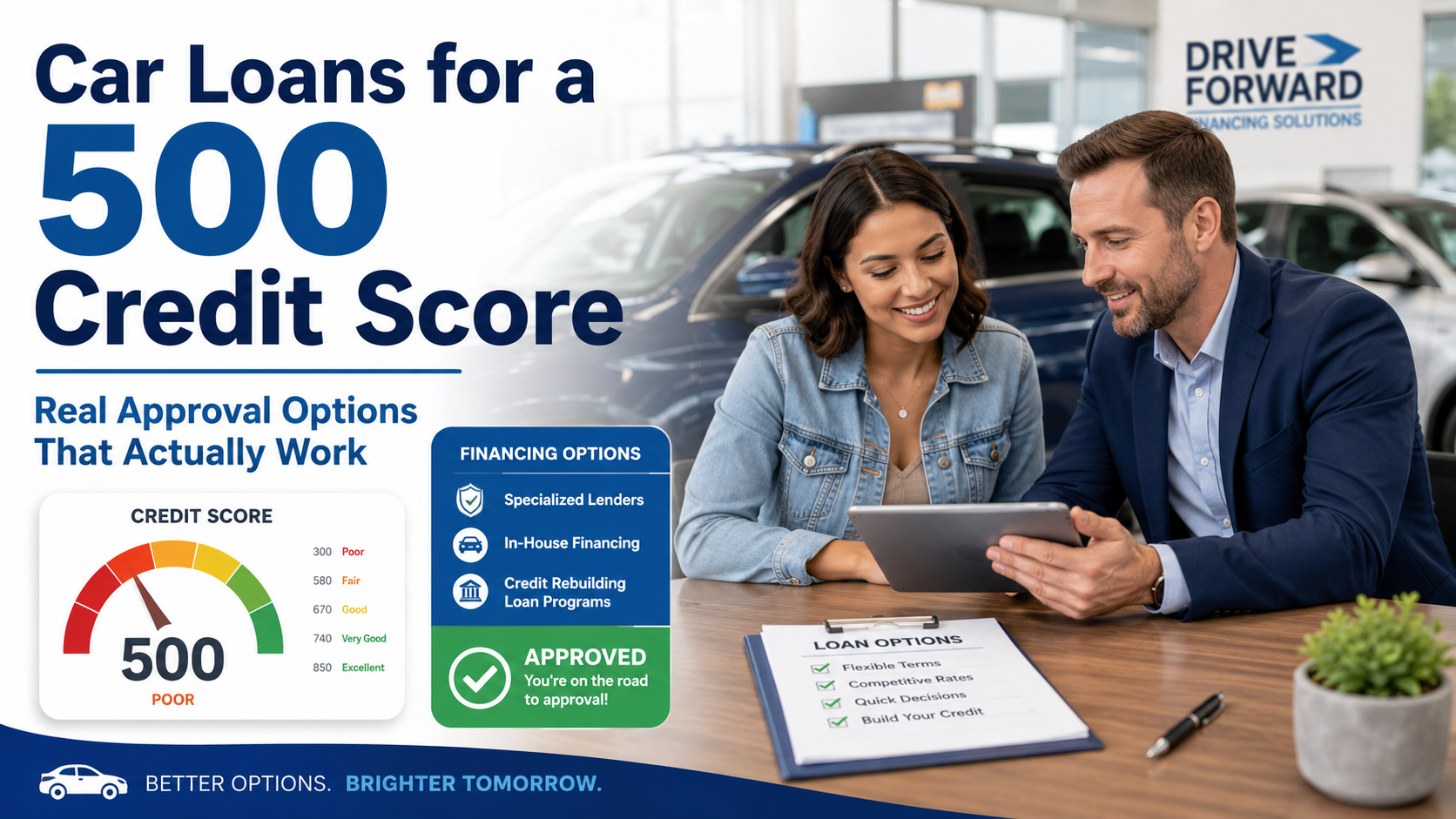
- A 500 FICO score lands you in the deep subprime tier, but auto loan approval is still possible through specialty lenders — CarFix Credit works with borrowers across all 50 US states regardless of credit history.
- Expect APRs between 17% and 22% for new vehicles and 19% to 25% for used vehicles at this credit tier, based on Experian’s Q4 2024 State of the Automotive Finance Market.
- A down payment of 10–20%, a co-signer with a 670+ score, or proof of stable income over $1,800/month dramatically improves your approval odds and interest rate.
- Loan terms typically range from 48 to 72 months at this credit tier — and CarFix Credit offers options from $5,000 to $75,000 with terms up to 96 months for qualified borrowers.
- A 500-score auto loan can rebuild your credit by 60–100 points within 12 months when payments are made on time, opening better refinance options down the road.
A 500 credit score puts roughly 16% of US consumers in what FICO classifies as the deep subprime tier — and most traditional banks won’t return your call. But the auto lending market is bigger than your bank’s loan officer. Car loans for a 500 credit score are issued every day through subprime and specialty lenders who price for the risk, document the income, and get borrowers approved in minutes.
The catch isn’t whether you can get approved — it’s whether you can get approved on terms that don’t trap you. This guide breaks down the real APR ranges, the documents that matter most, the three levers that move your rate down, and the warning signs that separate a legitimate subprime lender from a predatory one.
CARFIX CREDIT
Wondering if a 500 Score Is Enough to Get Approved?
CarFix Credit specializes in subprime and deep subprime auto financing across all 50 US states. It only takes a few minutes — no credit check required to start.
Can You Actually Get a Car Loan with a 500 Credit Score?
Yes — a 500 credit score qualifies for auto financing through subprime and deep subprime lenders, though not through most prime banks or credit unions. The US auto finance market is tiered: prime lenders typically require a 670+ FICO score, near-prime starts at 601, subprime at 501, and deep subprime sits at 500 and below. A 500 score puts you on the boundary between the two riskiest tiers, which means lenders will look closely at the rest of your financial picture before issuing terms.
According to Experian’s Q4 2024 State of the Automotive Finance Market report, deep subprime borrowers accounted for roughly 5.6% of all auto originations in the US — a smaller slice, but still tens of thousands of loans funded every quarter. Lenders in this segment don’t underwrite the way prime banks do. They prioritize verifiable monthly income, employment tenure, and residence stability over the raw credit score alone.
If you understand how your credit score affects your loan, you’ll see why the 500 tier requires a different approach than a 650 application. The score itself isn’t the only filter — it’s what it tells the lender about your delinquency patterns and the trade lines on your file.
What APR Should You Expect on a 500-Score Car Loan?
A borrower with a 500 FICO score should expect an APR between 17% and 25% in 2026, depending on whether the vehicle is new or used and how strong the supporting application is. The Experian Q4 2024 data showed deep subprime average APRs of 15.81% on new vehicles and 21.58% on used — and rates have ticked up slightly through 2025 as the Federal Reserve held base rates higher for longer.
“The average APR for deep subprime auto loans on used vehicles reached 21.58% in Q4 2024, more than double the 9.63% average for prime borrowers.” — Experian State of the Automotive Finance Market
Here’s what that means in real dollars. On a $15,000 used vehicle financed over 60 months at 21% APR, you’ll pay roughly $406 per month and approximately $9,360 in total interest. The same loan at 8% APR (a prime borrower’s rate) would cost $304 per month and just $3,250 in interest. The rate gap is where deep subprime lenders price for risk — and where every point you can shave off matters. If the math feels overwhelming, spend a few minutes understanding your car loan terms before you sign anything, especially the difference between APR and interest rate and how amortization affects what you pay.
Use a loan calculator before you sign anything. A small bump in your down payment or a shorter term can change your total interest paid by thousands. CarFix Credit provides a tool to estimate your monthly payment across different loan amounts, APRs, and terms so you can see the tradeoffs before you commit.
The Three Levers That Move Your Approval — and Your Rate
At a 500 credit score, three factors carry more weight than the score itself: down payment, income stability, and the vehicle you choose. Improve any one of them and you improve your approval odds; improve all three and you can drop your APR by 3–5 percentage points compared to a bare-minimum application.
- Down payment of 10–20%. A $2,000 down payment on a $15,000 vehicle reduces the loan-to-value ratio (LTV) from 100% to roughly 87% — a major signal to subprime underwriters who lose money when borrowers default upside-down. Cash, trade-in equity, or a combination all count.
- Verifiable monthly income of $1,800+. Most subprime lenders set a minimum gross monthly income threshold of $1,500–$2,000. Pay stubs, bank statements, or tax returns work. Self-employed borrowers usually need two years of returns.
- A reasonably priced vehicle. Subprime lenders typically cap the loan-to-value at 120% of the wholesale value (often the Black Book or Kelley Blue Book figure). A modest used sedan or hatchback often gets approved faster than a luxury SUV at the same price point.
A fourth lever — a co-signer with a 670+ FICO score and proven income — can drop your rate even further, sometimes into the 13–15% range. The co-signer takes on full legal responsibility for the loan, so this is a conversation worth having carefully with a family member rather than a casual acquaintance.
⚠️ Buy Here Pay Here Trap: Buy Here Pay Here (BHPH) dealerships finance their own inventory in-house and rarely report payments to the credit bureaus. At a 500 score, you may be steered toward BHPH lots with APRs between 18% and 29%, no credit-building benefit, and aggressive repossession clauses. The CFPB has flagged BHPH loans for default rates above 30%. Always ask whether payments are reported to Experian, Equifax, and TransUnion before signing.
CARFIX CREDIT
Over 183,000 Americans Have Been Approved Through CarFix Credit.
Loan amounts from $5,000 to $75,000, terms from 12 to 96 months, and approval decisions in minutes. CarFix Credit serves all 50 US states and works with every credit type — including deep subprime borrowers in the 500–579 range.
What Documents You’ll Need to Apply
At a 500 credit score, lenders compensate for the credit risk by verifying every other detail of your application. Having documents ready before you apply shortens the underwriting timeline from days to hours. Most subprime auto applications request the same core set.
- Government-issued photo ID — a valid US driver’s license or state ID.
- Proof of income — most recent 30 days of pay stubs, or three months of bank statements for self-employed applicants.
- Proof of residence — a utility bill, lease agreement, or mortgage statement dated within 60 days.
- References — typically 4–6 personal and professional contacts who are not living at your address.
- Proof of auto insurance — full-coverage policy meeting your state’s minimums, required before the vehicle leaves the lot.
- Down payment funds — verified through bank statement screenshot or cashier’s check.
If you understand how the CarFix Credit process works, you’ll see the application is structured around these documents from the start — you upload once and lenders compete for your file rather than each one running a separate hard pull.
How a 500-Score Auto Loan Rebuilds Your Credit
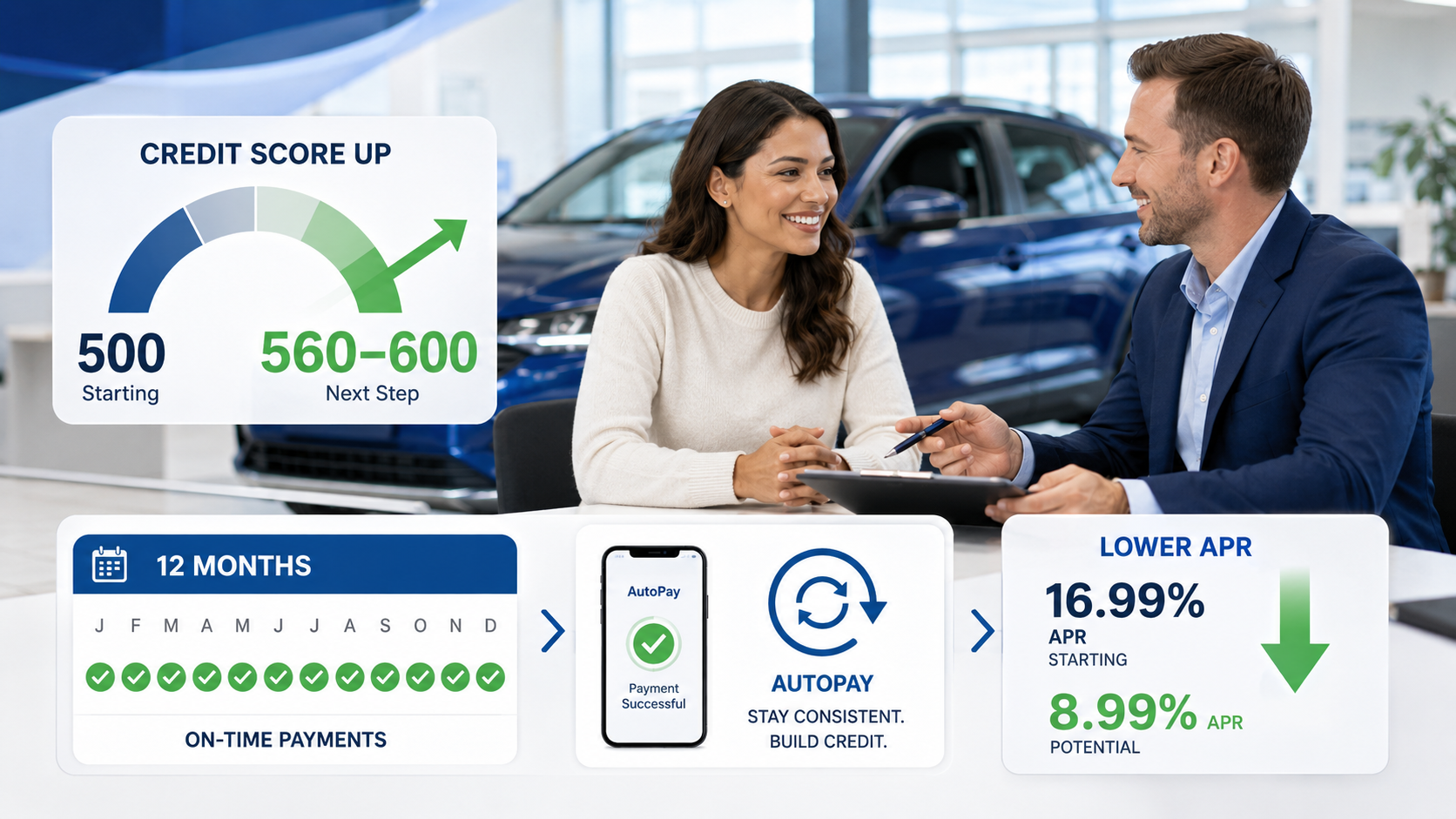
An on-time auto loan can lift a 500 credit score by 60 to 100 points within 12 months, provided the lender reports to all three major bureaus (Experian, Equifax, and TransUnion). Auto loans are installment debt, which diversifies your credit mix — a 10% input into your FICO calculation — and the on-time payment history accounts for 35%. Together, those two factors do most of the heavy lifting for credit rebuilding.
The math is straightforward. A borrower starting at 500 with no other open accounts who makes 12 consecutive on-time auto payments typically lands in the 560–600 range within a year. From there, refinancing becomes a real option. Many borrowers refinance their auto loan after 12–18 months of clean payments and drop their APR by 4–8 percentage points — often paying for the original loan’s higher initial rate several times over in interest saved.
The Consumer Financial Protection Bureau (CFPB) recommends setting up autopay to remove the risk of missing a payment by accident. A single 30-day late payment on a new auto loan can drop a rebuilding score by 50–80 points and reset the rebuilding clock. APR (annual percentage rate) is the total cost of borrowing expressed as a yearly percentage, including interest and any included fees — and your APR at refinance is directly tied to your payment history on the original loan.
Where 500-Score Borrowers Get Approved Across the US
Subprime auto financing is available in every US state, but local market dynamics shift the math. Texas, Florida, Georgia, and California have the highest concentration of subprime-friendly lenders thanks to large dealer networks and high vehicle ownership rates. Northeastern states like New York and Massachusetts tend to have stricter state usury caps — which is good for borrowers, since it puts a hard ceiling on the APR a lender can legally charge.
State sales tax and registration fees also affect the total amount financed. A $15,000 vehicle in Oregon (0% state sales tax) finances at a lower total than the same vehicle in Tennessee (7% state sales tax plus local) — meaning your monthly payment and total interest can vary by hundreds of dollars depending on where you register the car.
CarFix Credit operates nationwide and the application process is fully online. Whether you’re financing a sedan, SUV, truck, or powersports vehicle, you can explore more auto financing guides covering state-specific requirements, vehicle categories, and credit-building strategies for borrowers at every score tier.
Frequently Asked Questions
Can I get a car loan with a 500 credit score and no down payment?
Yes, you can get a car loan with a 500 credit score and no down payment through CarFix Credit, though it’s harder and the APR will sit at the high end of the 17–25% range. Lenders see down payments as proof of skin in the game, so $0 down at a deep subprime tier usually means a shorter approved loan amount or a higher rate. If you can put even 5% down, you significantly improve your odds and lower your monthly payment.
How much car can I afford with a 500 credit score?
With a 500 credit score, most subprime lenders cap the loan amount at 4–5 times your gross monthly income. So a borrower earning $2,500 per month would typically qualify for a loan in the $10,000–$12,500 range. CarFix Credit offers loan amounts from $5,000 to $75,000 with the actual approved amount depending on your income, debt-to-income ratio, and the vehicle’s wholesale value.
Will applying for a car loan hurt my 500 credit score?
Starting a pre-approval application does not hurt your credit score when the lender uses a soft credit pull. CarFix Credit lets you check your approval odds without any credit check to start. A hard pull happens only once you accept a specific loan offer, and a single hard pull typically drops a score by 3–5 points temporarily — fully recovered within a few months of on-time payments.
Is a co-signer required for a 500 credit score car loan?
A co-signer is not required for a 500 credit score car loan, but adding one with a 670+ FICO score can drop your APR by 3–5 percentage points and significantly raise the approved loan amount. The co-signer takes on full legal responsibility for the loan — including any missed payments — so it’s best reserved for trusted family members rather than friends or roommates.
How long until I can refinance a 500-score auto loan?
Most lenders require 12 months of on-time payments before they’ll consider refinancing a subprime auto loan. If your credit score has improved by 60+ points during that period — which is typical with consistent on-time payments — you can often drop your APR by 4–8 percentage points at refinance. That single move can save thousands in interest over the remaining loan term.
What’s the difference between subprime and deep subprime auto loans?
Subprime auto loans serve borrowers with FICO scores between 501 and 600, while deep subprime covers scores at 500 and below. The two tiers carry different APR ranges — deep subprime averaging 3–4 percentage points higher — and different lender requirements around down payment and income verification. A 500 score sits exactly on the boundary, which is why the strength of your supporting application matters so much at this tier.
Get Pre-Approved for a 500-Score Auto Loan Today
CarFix Credit helps Americans across all 50 states get approved for auto financing — regardless of credit history. Loan amounts from $5,000 to $75,000, terms from 12 to 96 months, and approval decisions in minutes.
- ✅ All credit types welcome — including bad credit and bankruptcy
- ✅ $0 down financing options available
- ✅ No credit check to start the application
- ✅ Approval decisions in minutes, fully online
📍 Address: 3401 N. Miami Ave, Suite 230, Miami, FL 33127
🌐 Website: carfixcredit.com
🇺🇸 Coverage: All 50 US states — fully online application
Bad credit. No credit. Bankruptcy. CarFix Credit helps you get on the road regardless.