
Auto Loan Denial: Top Reasons and How to Overcome Them

Carfixcredit | Updated April 2026 | 8 min read
Getting denied for an auto loan feels like a dead end. It isn’t.
A denial is information. It tells you something specific about your application that wasn’t strong enough for that particular lender at that particular moment.
Most of the reasons lenders decline applications are fixable, and understanding why auto loan applications get denied is the first step toward getting approved.
This guide covers the most common reasons lenders say no, what each one actually means, and what you can do about it before you apply again.
What Happens When You Get Denied
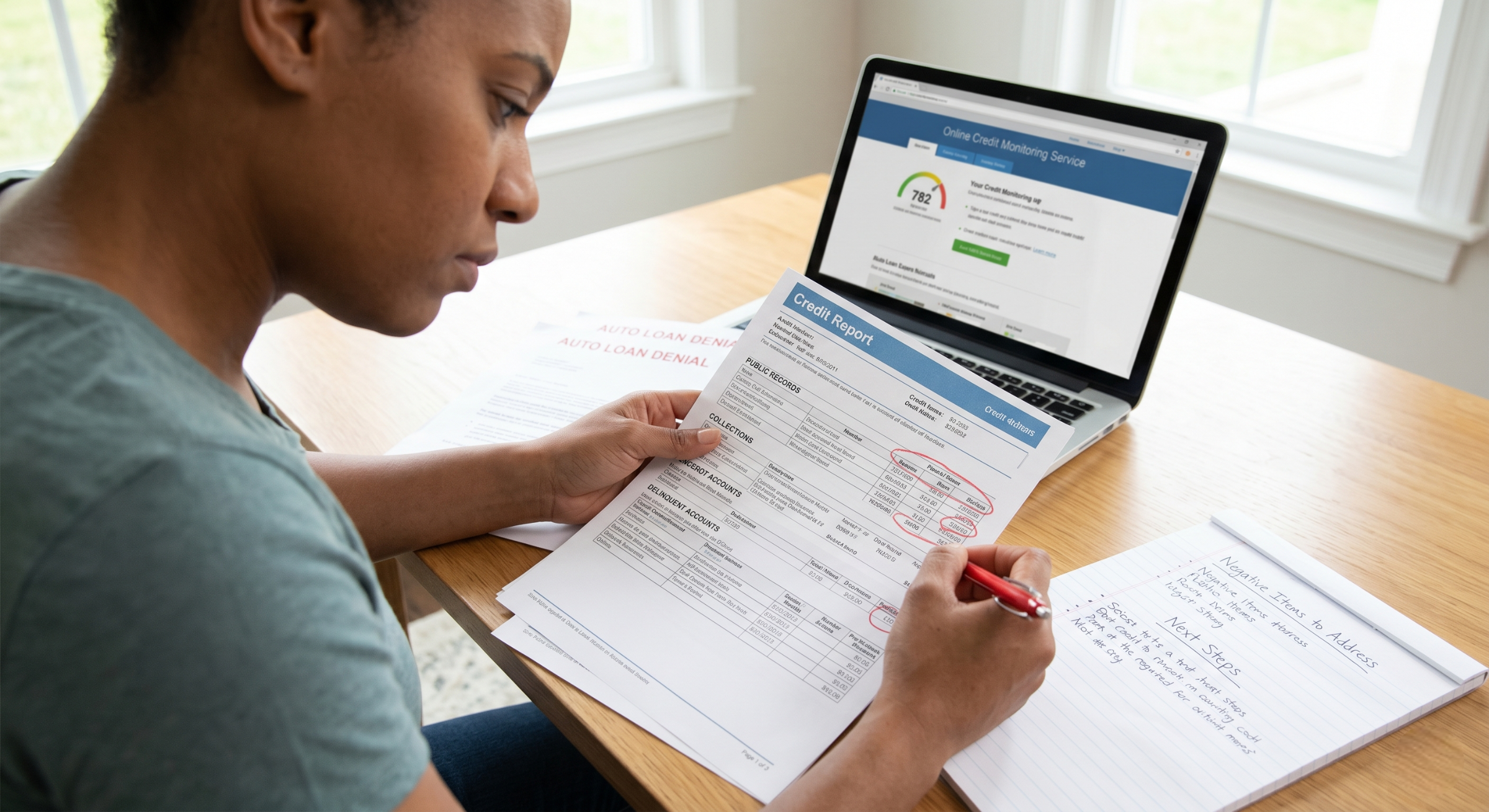
When a lender declines your application, they’re required by law to send you an adverse action notice. This document explains the specific reasons for the denial. It’s not always written in plain language but it contains the information you need to understand what went wrong.
Read it carefully. The reasons listed are the actual factors the lender used to make the decision. They’re your roadmap for what to address before you apply again.
Don’t throw it away. Don’t ignore it. It’s the most useful piece of information you’ll receive from the process.
Reason 1: Credit Score Too Low
This is the most common reason for a denial and the most straightforward to understand.
Every lender has a minimum credit score threshold for their standard loan products. If your score falls below that threshold, the application doesn’t move forward regardless of the rest of your profile.
The important thing to know is that a score below one lender’s threshold isn’t necessarily below everyone’s. Traditional banks and credit unions often have higher minimum scores than specialist lenders who work with challenged credit. A denial from one source doesn’t mean the market has closed on you.
What to do
First, find out your actual score if you don’t already know it. Free monitoring is available through most credit card providers and apps. Knowing the number tells you how far you are from the threshold and what level of lender to approach.
If your score is significantly below standard thresholds, focus on improving it before applying again. Pay down credit card balances, dispute any errors on your report, and make every payment on time from this point forward. Even a 20 to 30 point improvement can move you into a different lender tier.
If you need a vehicle now and can’t wait, approach lenders who specialize specifically in challenged credit profiles. The rate will be higher but the path to approval is more realistic than continuing to apply through standard channels.
Reason 2: Insufficient Income
The lender looked at your income relative to the proposed payment and decided the monthly obligation wasn’t manageable for your situation.
Most lenders use a payment-to-income ratio as part of their underwriting. They want to see the monthly payment sitting below a certain percentage of your verified monthly income. If the proposed payment pushes past that threshold, the application gets declined even if your credit score is reasonable.
What to do
There are three practical levers here.
Increase the down payment to reduce the loan amount and lower the monthly payment. A larger down payment directly reduces the payment-to-income ratio without changing your income.
Choose a less expensive vehicle. A lower purchase price means a smaller loan and a lower payment. If the vehicle you applied for produces a payment that’s too high relative to your income, stepping down to a more affordable option can change the underwriting outcome.
Extend the loan term. A longer term reduces the monthly payment. This increases total interest paid but it addresses the payment-to-income concern. It’s a tradeoff worth understanding clearly before you use it.
Reason 3: High Debt-to-Income Ratio
This is related to income but distinct from it. Your debt-to-income ratio measures how much of your monthly income is already committed to existing debt payments.
A buyer making $4,000 a month with $2,800 already going toward credit cards, student loans, and other installment debt has very little room for a new car payment regardless of their credit score. Lenders see that constraint and decline the application because adding more debt creates a payment structure that’s genuinely fragile.
What to do
Paying down existing debt is the most direct fix. Eliminating a credit card balance or paying off a small installment loan reduces your monthly obligations and improves your ratio before you apply again.
If paying down debt isn’t immediately possible, the down payment and vehicle price levers apply here too. A smaller loan amount means a smaller payment, which means less additional debt being layered onto an already stretched ratio.
Reason 4: Employment or Income Instability
Lenders want to see that your income is reliable and consistent. A recent job change, a gap in employment, variable income that’s hard to verify, or self-employment without sufficient documentation can all trigger a decline even when the income level looks adequate on paper.
The question lenders are asking isn’t just how much you make. It’s how confident they are that you’ll keep making it for the duration of the loan.
What to do
If you recently started a new job, waiting until you have at least six months, and ideally a year, of employment history at your new employer before applying again strengthens the stability signal significantly.
For self-employed buyers, having clean tax returns for two consecutive years and bank statements showing consistent deposits gives lenders something concrete to evaluate. The more documentation you can provide showing consistent, verifiable income over time, the less uncertainty the lender has to price into their decision.
Reason 5: Loan Amount Too High Relative to Vehicle Value
Lenders care about the loan-to-value ratio. If the amount you’re asking to borrow is significantly higher than the vehicle’s market value, the lender’s collateral risk is too high.
This comes up most often when a buyer is rolling negative equity from a previous loan into a new one, when dealer fees and add-ons push the financed amount above book value, or when the vehicle being purchased is priced above what comparable vehicles are selling for in the market.
What to do
A larger down payment reduces the loan amount relative to the vehicle value. Even a modest increase in the down payment can bring the LTV ratio within acceptable limits.
If the vehicle is priced above its market value, that’s worth addressing at the negotiation stage rather than after a denial. Knowing the book value of the vehicle before you agree to a price gives you a clearer picture of whether the loan structure will underwrite.
Reason 6: Too Many Recent Credit Inquiries
Every formal credit application triggers a hard inquiry on your credit report. One or two inquiries have a minor impact. Multiple inquiries in a short period create a pattern that some lenders interpret as financial stress, as if you’re urgently trying to find credit from any source willing to approve you.
This can lower your score modestly and make some lenders cautious regardless of your overall profile.
What to do
When you’re shopping for an auto loan, apply with multiple lenders within a short window, typically 14 to 45 days. Credit bureaus treat multiple auto loan inquiries within that window as a single inquiry for scoring purposes. That’s rate shopping protection built into the system and you should use it.
Avoid applying for unrelated credit, credit cards, personal loans, or other products, in the months leading up to a car loan application. Those inquiries don’t receive the same rate shopping treatment and each one adds to the count.
Reason 7: Derogatory Marks on Your Credit Report
Collections, charge-offs, late payments, and bankruptcies all leave marks on your credit report that lenders evaluate alongside your score.
A score in the fair range with several recent collections tells a different story than the same score with an older isolated late payment and a clean record since. Lenders look at what’s on the report, not just the number it produces.
What to do
Pull your full credit report before you apply anywhere. Review it for any marks you weren’t aware of and for anything that looks inaccurate.
Errors are more common than most people expect. A collection account that was paid but still shows as open, a late payment reported on the wrong date, an account that doesn’t belong to you. Disputing legitimate errors is free and can remove negative marks that are dragging your score down unfairly.
For accurate negative marks, time and consistent positive behavior are the main tools. Recent derogatory marks have more impact than older ones. Building clean payment history from this point forward reduces the relative weight of past marks over time.
Reason 8: No Credit History
Some lenders decline applications not because of bad credit but because of no credit. Without a track record to evaluate, they’re uncertain about the risk and some of them respond to that uncertainty by declining rather than approving.
What to do
A co-signer with established credit is the most effective tool for a no-credit buyer. The lender evaluates both profiles and the stronger credit history carries significant weight.
A larger down payment also helps by reducing the lender’s risk exposure on an application that has limited credit history to support it.
Credit unions with first-time buyer programs and online lending networks that specialize in thin-file applicants are the most accessible lender options for buyers in this situation.
What to Do Immediately After a Denial
Read the adverse action notice and identify the specific reasons. This is your starting point.
Check your credit report for errors. A denial is a prompt to review what lenders are actually seeing when they pull your report. Something inaccurate on there deserves to be disputed before you apply again.
Assess which reasons are immediately addressable and which require more time. A down payment shortfall can sometimes be solved quickly. A credit score that needs significant improvement takes months. Knowing the timeline helps you decide whether to address the issue before applying again or to approach a different type of lender now.
Don’t apply to multiple lenders in rapid succession without addressing the underlying issue. Stacking denials adds hard inquiries to your report without improving your approval odds. Fix what you can fix first.
Getting pre-approved through a lender that works with your specific credit situation is a better use of your next application than resubmitting to a lender who’s already told you their threshold doesn’t match your profile.
When a Denial Is Actually Useful
This sounds counterintuitive but a denial from a lender whose standards you don’t meet is better than an approval with terms that don’t work for your situation.
A lender who declines your application at 6.5 percent has told you something useful. You now know the threshold you need to reach for that type of financing. That’s a target. A lender who approves you at 22 percent for a longer term than you need on a vehicle that’s more than you can comfortably afford hasn’t done you any favors.
The goal isn’t approval from any source at any terms. It’s an approval that produces a loan you can manage comfortably, at a rate that reflects your actual credit profile fairly, on a vehicle that makes sense for your budget.
A denial that sends you back to fix something real puts you closer to that outcome than a bad approval does.
The Bottom Line
A denied auto loan application isn’t a permanent answer. It’s a specific response to a specific application at a specific moment.
Understanding what triggered the denial, addressing it where you can, and approaching the right lender for your actual profile puts you in a completely different position the next time around.
Most people who get denied and work through the process end up approved. It sometimes takes more time or a different lender or a structural change to the application. But the path forward almost always exists.
How Carfixcredit Helps After a Denial
A denial from one lender doesn’t mean the market is closed. Carfixcredit connects buyers across the United States with lenders who work with real financial situations including challenged credit, limited history, and previous declines.
Checking what you qualify for takes about two minutes and won’t affect your credit score. Finding out where you actually stand is always better than assuming the answer is still no.