
How to Get Pre-Approved for a Car Loan in 5 Steps

Carfixcredit | Updated April 2026 | 7 min read
Walking into a dealership without a pre-approval is one of the most common mistakes car buyers make.
You end up negotiating blind. You don’t know your rate, you don’t know your budget ceiling, and the finance manager knows things about your situation that you don’t. That’s not a great position to be in when you’re about to commit to years of monthly payments.
Getting pre-approved before you shop flips that dynamic completely. You know your number. You know what you qualify for. And the dealer’s financing offer becomes something to compare rather than something to accept.
Here’s exactly how to do it in five steps.
Step 1: Check Your Credit Report and Score
Before any lender looks at your credit, you should.
Pull your free credit report from each of the three major bureaus, Equifax, Experian, and TransUnion, through AnnualCreditReport.com. Go through each one carefully and look for anything that doesn’t look right.
Errors on credit reports are more common than most people expect. Payments incorrectly reported as late, accounts that don’t belong to you, balances that don’t match your records. Any of these can drag your score down without reflecting your actual credit behavior.
If you find errors, dispute them before you apply anywhere. The process takes a few weeks but a corrected error can move your score meaningfully and that movement directly affects the rate you’re offered.
Also check your actual score. Free monitoring is available through most credit card providers and apps like Credit Karma. Knowing your score going in means no surprises when a lender pulls it. It also helps you understand what rate range to expect before anyone quotes you a number.
Step 2: Figure Out Your Budget
Pre-approval tells you the maximum you can borrow. It doesn’t tell you the maximum you should borrow.
Those are two different numbers and confusing them is how people end up with a car payment that dominates their monthly finances.
Before you apply anywhere, work out what you can realistically afford every month. A common guideline is keeping total vehicle expenses, including the loan payment, insurance, fuel, and maintenance, under 15 to 20 percent of your monthly take-home pay.
Start with that monthly number and work backward. Use an online auto loan calculator to figure out what purchase price that monthly budget translates to at a realistic rate and loan term. That’s your actual ceiling, not the maximum a lender will approve you for.
Knowing your real budget before you get pre-approved means you can use the pre-approval as a tool rather than a permission slip to spend as much as possible.
Step 3: Gather Your Documents
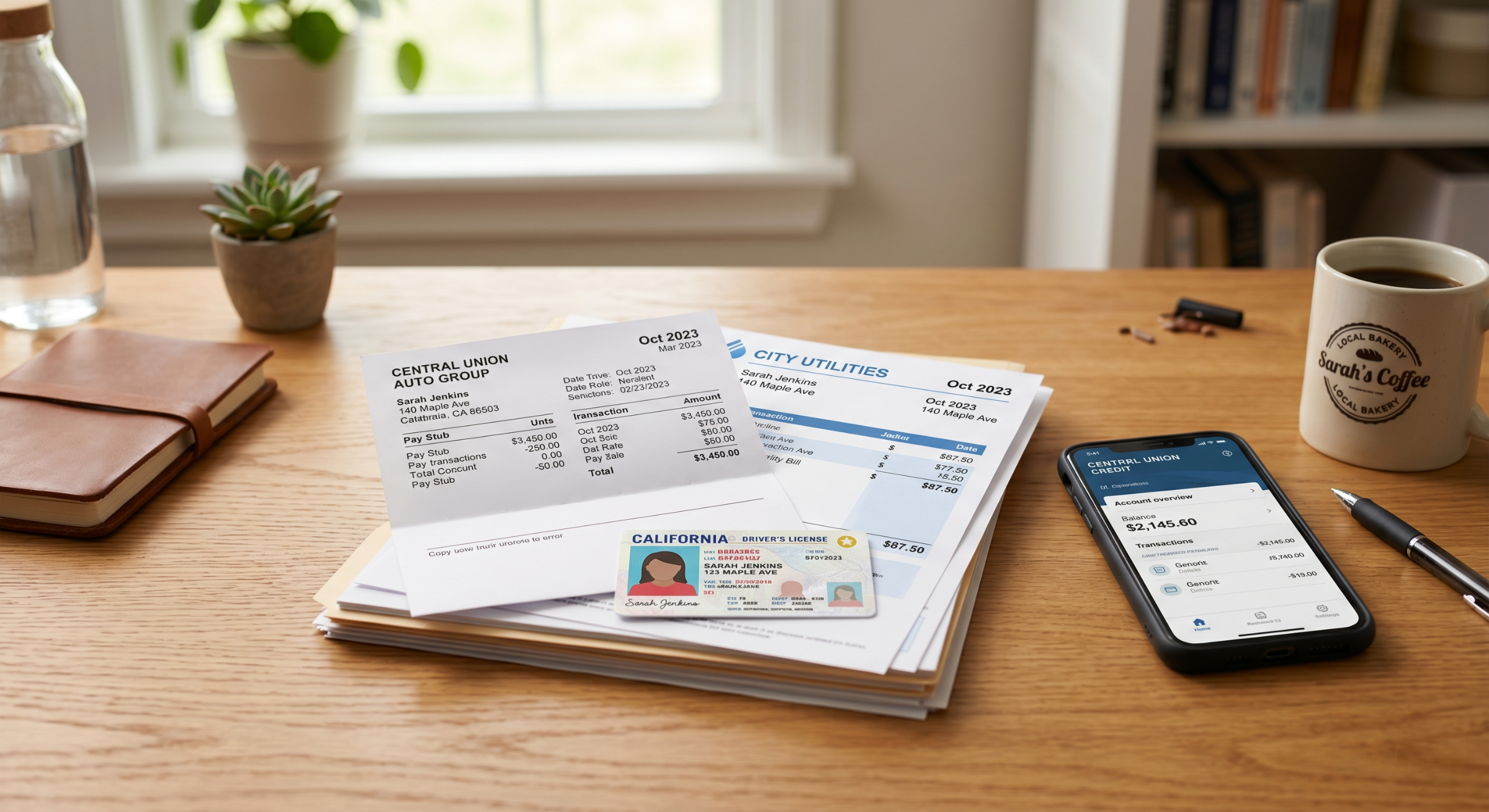
Pre-approval applications are straightforward but having your documents ready before you start speeds everything up and reduces the chance of delays.
Here’s what most lenders will ask for.
Proof of identity. A valid government-issued photo ID, typically a driver’s license or passport.
Proof of income. Recent pay stubs covering the last 30 days are the standard. If you’re self-employed, tax returns from the last two years and recent bank statements are usually required instead.
Proof of residence. A utility bill, bank statement, or lease agreement showing your current address.
Employment information. Your employer’s name, address, and how long you’ve been there. Stable employment history works in your favor.
Social Security number. Required for the lender to pull your credit.
Vehicle information. Some lenders ask for this upfront, particularly if you have a specific vehicle in mind. Others approve you for a loan amount first and ask about the vehicle later.
Having all of this ready before you start your first application means you can complete the process without stopping to hunt for documents.
Step 4: Apply With Multiple Lenders
This is the step most first-time buyers skip because they worry about the impact on their credit score.
Here’s what actually happens. Each application triggers a hard inquiry which causes a small, temporary dip in your score. But when you apply with multiple lenders for the same type of loan within a short window, typically 14 to 45 days, the credit bureaus treat all of those inquiries as a single inquiry for scoring purposes.
That’s rate shopping protection built into the system. You’re supposed to compare offers. The bureaus account for that.
So apply with more than one lender. A bank or credit union you already have a relationship with is a good starting point. Applying for car loan pre-approval online is often the fastest way to see multiple offers quickly without walking into multiple offices.
Compare the APR across each offer, not just the monthly payment. The APR tells you the actual cost of borrowing and is the right number to compare when you’re evaluating competing offers side by side.
Also pay attention to the loan term each lender is quoting you. Two offers with the same monthly payment but different terms are not the same offer. The longer term loan costs you more in total interest even if the payment looks identical.
Step 5: Review Your Pre-Approval and Use It
Once you have your pre-approval offer, read through it carefully before you do anything else.
Check the APR, the loan term, the maximum loan amount, and whether there are any conditions attached to the approval. Some pre-approvals are conditional on income verification or on the vehicle meeting certain criteria around age and mileage. Know what you’re working with before you go shopping.
A pre-approval is typically valid for 30 to 60 days depending on the lender. That’s your window to find a vehicle and complete the purchase.
When you sit down with the dealership’s finance manager, share your pre-approval. Ask them if they can beat it. Sometimes they can, particularly if they have access to a lender offering a promotional rate. If they can, great. If they can’t, you already have a solid offer ready to go and you’re not dependent on whatever their network happens to produce for your profile.
That’s the whole point of pre-approval. It shifts the dynamic so you’re evaluating an offer rather than accepting one.
What Happens After Pre-Approval
Pre-approval is not the same as final approval. Here’s the distinction.
Pre-approval is based on the information you provided and a credit check. It tells you that a lender is willing to lend you up to a certain amount at a certain rate, subject to final verification.
Final approval happens after you’ve chosen a specific vehicle. The lender verifies the vehicle’s value, confirms all your documentation, and issues the formal loan agreement. In most cases this is a formality if your pre-approval was solid and you’ve chosen a vehicle within your approved amount.
A few things can affect final approval even after pre-approval. A significant change in your financial situation between pre-approval and purchase, like losing a job or taking on new debt, can cause issues. Choosing a vehicle that doesn’t meet the lender’s criteria around age or mileage can also create a problem. Keep your financial situation stable and your vehicle choice reasonable and final approval is usually straightforward.
Pre-Approval With Challenged Credit
If your credit is not in great shape, getting pre-approved is still worth doing. It just requires the right lenders.
Traditional banks and credit unions may decline or offer limited terms for buyers with challenged credit. Specialist lenders and online lending networks that match you across multiple lenders simultaneously are more likely to produce a useful pre-approval offer.
A pre-approval with a higher rate is still useful. It tells you exactly what your budget looks like, it gives you something to compare the dealer’s offer against, and it means you’re walking in with a plan rather than hoping the dealership can find something that works.
Getting pre-approved for a car loan with bad credit is more straightforward than most people expect when you work with lenders built for that situation.
Common Pre-Approval Mistakes to Avoid
Applying for multiple types of credit at the same time. Rate shopping for a car loan within a short window is fine. Applying for a car loan, a credit card, and a personal loan simultaneously is a different story. That pattern looks like financial stress to lenders and can affect your approval odds.
Changing jobs between pre-approval and final approval. Employment stability is part of what lenders are evaluating. A job change during this window, even a positive one, can complicate final approval. If possible, hold off until after the purchase is complete.
Making large purchases on credit before finalizing the loan. New debt changes your debt-to-income ratio. A significant credit card purchase or another installment loan taken out before your auto loan closes can affect your final approval terms.
Waiting too long to use the pre-approval. Most pre-approvals expire within 30 to 60 days. If you’re not ready to buy within that window, the application process will need to be repeated and your rate may have changed.
The Bottom Line
Pre-approval takes maybe 30 minutes spread across a couple of applications. It costs nothing. And it completely changes the position you’re in when you sit down to talk financing at a dealership.
You know your rate. You know your budget. You have something concrete to compare any offer against. That’s not a small advantage. Over the life of a multi-year loan, it can be worth thousands of dollars in interest saved just from knowing what you qualify for before someone else tells you what to accept.
Do the 30 minutes. It’s worth it.
How Carfixcredit Makes Pre-Approval Simple
Whether your credit is strong, challenged, or somewhere in between, Carfixcredit connects you with lenders across the United States who work with real financial situations.
The process takes about two minutes and checking what you qualify for won’t affect your credit score.
If you’re ready to find out where you stand before you start shopping, that’s where to start.