
Vehicle Financing by Type: Cars, Trucks, SUVs & More

Carfixcredit | Updated April 2026 | 18 min read
Not all vehicles finance the same way.
The type of vehicle you’re buying affects your loan amount, your interest rate, your insurance cost, and sometimes even which lenders will work with you. A full-size pickup truck and a compact sedan are very different financing conversations, even if the price tag is similar.
Most buyers find a vehicle they like and then figure out the financing. The smarter move is understanding how financing works for each vehicle type before you start shopping. It changes what you look for and how you negotiate.
This guide covers everything. Cars, trucks, SUVs, crossovers, minivans, electric vehicles, and commercial vehicles. How each one finances differently and what to watch for in each category.
Why Vehicle Type Affects Your Financing
Before we get into each category, it helps to understand why the type of vehicle matters to lenders in the first place.
Lenders use the vehicle as collateral. If you stop making payments, they take the car back. So they care deeply about what that vehicle is worth now and what it’s likely to be worth later.
Depreciation rates, reliability history, market demand, and resale value all factor into how a lender evaluates a loan. A vehicle that holds its value gives them better collateral. A vehicle that depreciates fast creates more risk.
That risk shows up in your rate and your terms.
Financing a Car
Cars are the most straightforward financing category. Sedans, coupes, hatchbacks, and compact vehicles fall here.
They’re typically the least expensive vehicles to finance. Lower purchase prices mean smaller loan amounts, lower monthly payments, and less total interest paid.
Lenders are comfortable with cars. The market for them is large, parts are widely available, and resale value on popular models is predictable. That comfort usually translates into more competitive rates compared to larger or more specialized vehicles.
Cars also tend to be cheaper to insure, which matters when you’re calculating the real monthly cost of ownership beyond the loan payment.
What to watch for with car financing
Older, high-mileage sedans can hit lender restrictions around vehicle age and mileage. Most lenders won’t finance vehicles over a certain age or mileage threshold regardless of price. Check with your lender before you fall in love with a specific vehicle.
Small loan amounts sometimes come with fewer lender options. Some lenders have minimum loan thresholds and a low-priced car might fall below them.
Financing a Truck
Trucks are one of the most financed vehicle types in the United States. Full-size pickups like the Ford F-150, Chevrolet Silverado, and Ram 1500 are consistently among the best-selling vehicles in the country.
They also tend to be among the most expensive.
A new full-size truck can easily run $45,000 to $70,000 or more depending on trim level. That means larger loan amounts, higher monthly payments, and more total interest over the life of the loan.
The good news is trucks hold their value well. Popular full-size pickups depreciate more slowly than most cars, which means better collateral for lenders and a lower risk of going deeply underwater on the loan.
Used trucks can be a smart financing move for this reason. A two or three year old truck has taken the biggest depreciation hit already and still has plenty of useful life left.
What to watch for with truck financing
Trim level creep is real. It’s easy to add $10,000 to a truck purchase by moving up through trim levels and adding packages. Every dollar added to the purchase price is a dollar you’re financing and paying interest on. Be intentional about what you actually need versus what looks good on the lot.
Fuel costs are part of the real monthly expense. Full-size trucks are not fuel-efficient. Factor that into your monthly budget alongside the loan payment.
Commercial use affects insurance. If you’re using the truck for business, your personal auto insurance may not cover it. Get clarity on coverage before you finalize the purchase.
Financing an SUV
SUVs sit in a wide pricing range and a wide range of financing situations.
A compact SUV like a Honda CR-V or Toyota RAV4 finances more like a car. Prices are reasonable, depreciation is manageable, and lenders are comfortable with the collateral.
A large luxury SUV like a Cadillac Escalade or Lincoln Navigator is a completely different conversation. Purchase prices can rival high-end sports cars and financing terms reflect that.
SUVs as a category hold value reasonably well, especially popular models with strong reputations. That works in your favor from a financing standpoint.
What to watch for with SUV financing
The SUV market is crowded. There are more SUV options at more price points than almost any other vehicle category. That’s good for buyers because competition keeps prices from getting too inflated at the dealership level.
Luxury SUV financing requires stronger credit. Lenders get more particular at higher loan amounts. If your credit is challenged, starting in the mid-range SUV category and moving up later is a smarter play than trying to finance a luxury model before your credit is ready for it.
All-wheel drive adds cost and affects insurance. AWD is standard on many SUVs now but it adds to the purchase price and slightly increases insurance premiums. Worth knowing before you compare trim levels.
Financing a Crossover
Crossovers are technically built on car platforms rather than truck platforms, which makes them closer to cars from a financing standpoint than traditional SUVs.
The distinction matters less to most buyers than it does to engineers. From a financing perspective, crossovers behave similarly to SUVs in the mid-range price bracket.
Popular crossovers like the Toyota Camry-based Highland or the Subaru Outback depreciate at reasonable rates and are comfortable collateral for lenders. Financing terms tend to be competitive for this reason.
What to watch for with crossover financing
The line between compact SUV and crossover is blurry in the market. Don’t let the label confuse you. Focus on the price, the depreciation history of the specific model, and how the loan terms compare across similar vehicles.
Financing a Minivan
Minivans get overlooked in a lot of financing conversations but they’re worth talking about.
They’re practical, they tend to be priced below large SUVs, and popular models like the Toyota Sienna and Honda Odyssey have strong resale value because demand for them is consistent.
From a lender’s perspective, minivans are solid collateral. Predictable resale value and strong demand make them low-risk vehicles to finance.
Monthly payments on minivans are often lower than comparable three-row SUVs even though the functionality is similar. That’s a value argument worth considering if you’re choosing between the two.
What to watch for with minivan financing
Insurance on minivans is typically reasonable. Lower sports or performance profile means lower premiums in most cases.
Resale value drops more steeply on older, higher-mileage minivans. If you’re buying used, pay attention to the mileage relative to the asking price to make sure the financing makes sense.
Financing an Electric Vehicle
Electric vehicle financing is evolving fast and there are a few things that work differently compared to traditional vehicles.
Purchase price and incentives
EVs tend to carry higher sticker prices than comparable gas-powered vehicles. However, federal tax credits and state incentives can reduce the effective purchase price significantly. The federal EV tax credit currently runs up to $7,500 for qualifying vehicles and buyers. Some states stack additional credits on top of that.
These incentives can change the financing math substantially. A $45,000 EV with a $7,500 credit is effectively a $37,500 purchase, which changes the loan amount, the monthly payment, and the total interest paid.
Depreciation considerations
EV depreciation is less predictable than traditional vehicles right now because the market is newer and technology is changing fast. Some models hold value well. Others depreciate quickly as newer, better options come to market. Research the specific model’s depreciation history before you commit.
Lender familiarity
Most mainstream lenders are comfortable financing EVs now. Specialty EV brands with less dealer infrastructure may be harder to finance through traditional channels. Online lenders and manufacturer financing tend to be the most accessible options for newer EV brands.
What to watch for with EV financing
Battery replacement cost is a real consideration. A battery replacement on some EVs can run tens of thousands of dollars. Manufacturer warranties typically cover batteries for 8 years or 100,000 miles. Know what happens after that coverage ends before you commit to a long loan term.
Charging infrastructure affects your real cost of ownership. If you can charge at home, the fuel savings over a gas vehicle are significant. If you rely entirely on public charging, the savings are less pronounced.
Financing a Used Vehicle
Used vehicle financing deserves its own section because the rules are different from new car financing.
Rates on used vehicles are typically higher than on new vehicles. Lenders see more uncertainty in used cars because the condition, history, and remaining useful life are less predictable than a brand-new vehicle.
The age and mileage of the vehicle matter a lot. Most lenders have cutoffs, often around 10 years old or 100,000 to 150,000 miles. Vehicles beyond those thresholds may be harder to finance through standard lenders and may require a larger down payment or a higher rate.
Certified pre-owned vehicles sometimes qualify for rates closer to new vehicle financing because the manufacturer has inspected and certified them. CPO programs reduce the uncertainty that makes lenders cautious about used cars.
What to watch for with used vehicle financing
Get a vehicle history report before you commit. A car with a clean history is easier to finance and easier to insure than one with accidents or title issues on record.
Financing a used car with challenged credit is very possible but the combination of subprime credit and a high-mileage vehicle can limit your lender options significantly. Keeping the vehicle price and mileage reasonable gives your application the best chance.
Financing a Luxury Vehicle
Luxury vehicles come with luxury loan amounts. That changes the financing conversation significantly.
Lenders get more selective at higher price points. Stronger credit, higher income documentation, and sometimes a down payment become more likely requirements as the purchase price climbs.
Luxury vehicles also depreciate in specific ways. Some hold value extremely well. Others drop fast, particularly if the manufacturer releases a significantly updated model shortly after your purchase.
Leasing is more common in the luxury segment than outright purchase financing. Monthly lease payments on luxury vehicles are often significantly lower than loan payments for the same vehicle because you’re only paying for the depreciation during the lease period rather than the full purchase price.
If buying rather than leasing, gap insurance is particularly important on luxury vehicles given the depreciation exposure.
What to watch for with luxury vehicle financing
Maintenance and repair costs on luxury vehicles are higher than on mainstream brands. Factor that into your total monthly cost of ownership.
Insurance on luxury vehicles is substantially higher. Get an insurance quote before you finalize the purchase decision, not after.
Financing a Commercial Vehicle
Commercial vehicles, vans, work trucks, and vehicles used for business purposes finance differently from personal vehicles.
Personal auto loans typically don’t cover vehicles used for commercial purposes. You’ll generally need a commercial auto loan, which is a different product with different underwriting criteria.
Commercial loans look at your business credit and revenue in addition to your personal credit profile. Newer businesses or sole proprietors may find this more complicated than established businesses with a clean commercial credit history.
Some dealerships have commercial finance departments that handle this specifically. Online lenders with commercial vehicle products are also increasingly accessible for small business buyers.
What to watch for with commercial vehicle financing
Tax deductions on commercial vehicles can be significant. Work with your accountant before finalizing the loan structure to make sure you’re taking advantage of any applicable deductions.
Insurance requirements for commercial vehicles are different from personal auto. Commercial use requires commercial coverage. Running a business vehicle on a personal policy creates real liability exposure.
How Credit Score Affects Financing Across All Vehicle Types
Regardless of what you’re financing, your credit score is the biggest variable in your loan.
Strong credit opens up more lenders, better rates, and more flexibility on vehicle type and price range. Challenged credit narrows options but doesn’t eliminate them. The right lender for your credit profile exists across most vehicle categories.
The relationship between credit score and vehicle type works in both directions. Your credit affects what you can finance. The vehicle you choose affects how easy your credit makes it to get approved.
Keeping those two things aligned, choosing a vehicle your credit profile can comfortably support, is one of the more practical things you can do before you start shopping.
Comparing Total Cost of Ownership Across Vehicle Types
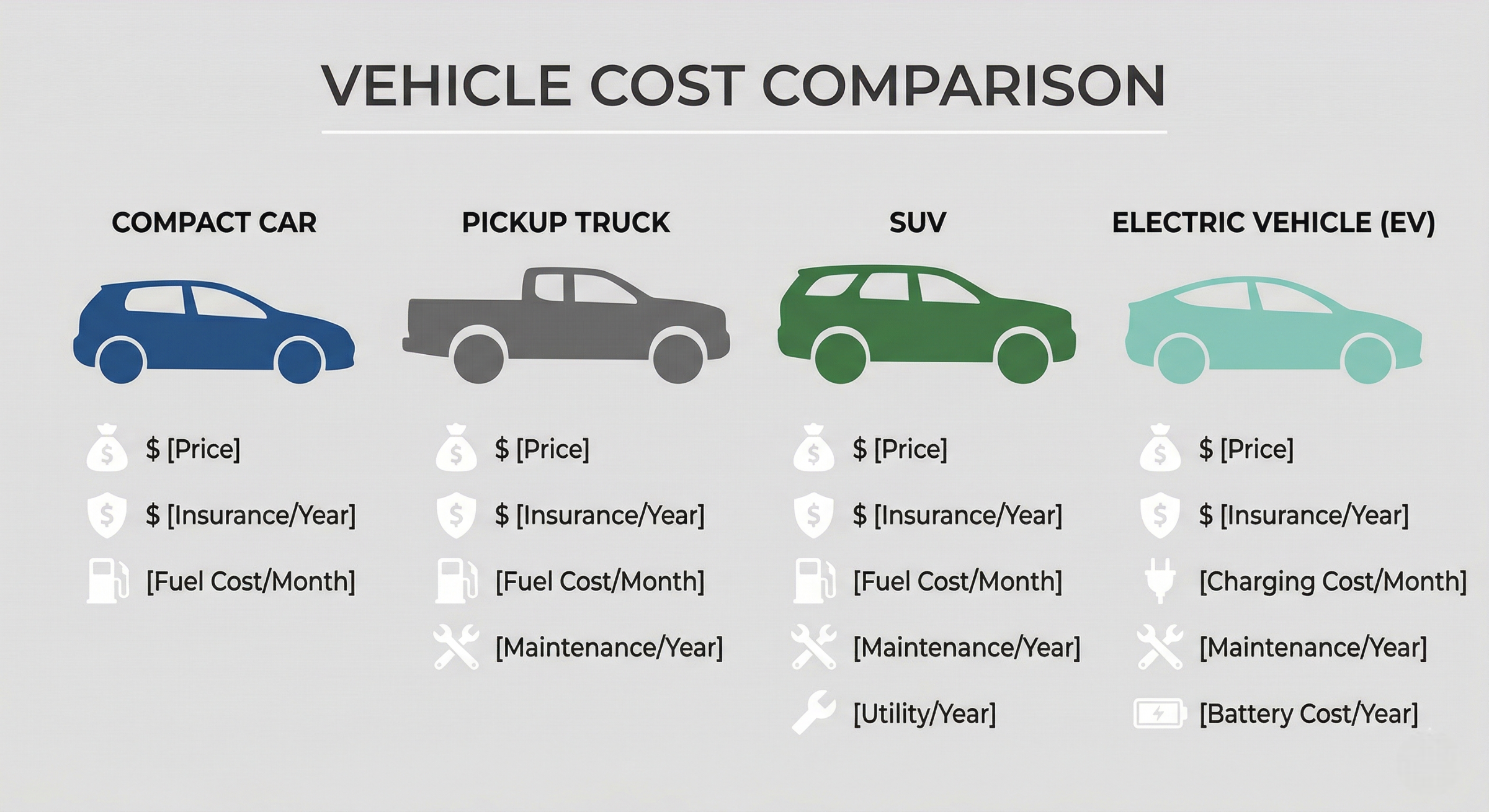
The loan payment is only part of what a vehicle costs you monthly.
Here’s a rough framework for thinking about total monthly cost across vehicle types.
Cars tend to have the lowest total cost across all categories. Lower purchase price, lower insurance, reasonable fuel costs.
Crossovers and compact SUVs add modest insurance and fuel costs over cars but stay manageable for most buyers.
Full-size SUVs and trucks carry higher insurance, higher fuel costs, and higher loan payments. The total monthly number can be significantly higher than it appears when you’re only looking at the payment.
EVs have higher purchase prices but lower fuel and maintenance costs. The math varies by model and driving habits.
Luxury vehicles carry the highest total cost across almost every category including insurance, maintenance, fuel where applicable, and loan payment.
Running the full monthly number before you commit to a vehicle type helps you make a decision that holds up over time and not just one that feels affordable based on the monthly payment alone.
How Carfixcredit Helps With Vehicle Financing Across All Types
Whatever you’re financing, the starting point is the same. You need a lender who fits your credit situation and your vehicle choice.
Carfixcredit connects buyers with a network of lenders across the United States who work with real credit profiles, not just the easy approvals. Whether you’re financing a used sedan, a full-size truck, an SUV for the family, or getting into your first EV, the network is built to find what’s actually available for your specific situation.
Checking what you qualify for takes two minutes and won’t affect your credit score.
Know what you can get approved for before you walk onto a lot. It makes every conversation after that easier.