
Zero Down Car Loans with Bad Credit: Is It Possible?
Carfixcredit | Updated April 2026 | 8 min read
You’ve probably already searched this one a few times.
And the answers you got were either sales pitches or a long list of reasons it might not work for you.
So let’s just be straight about it. Yes, 0 or little down car loans with bad credit are real.
People get them every day. But there’s more to the story than the ads make it look, and you should know what you’re walking into before you sign anything.
This one’s for anyone who needs a car, doesn’t have thousands sitting in savings, and has a credit score that’s working against them.
Here’s how it actually works.
What “zero down” actually means
Zero down means you don’t put any of your own money up at the time of purchase. The full price of the car, plus taxes, fees, and anything else baked in, gets rolled into the loan.
Sounds great on paper. No upfront cash. Just sign and drive.
But here’s what nobody tells you. The day you drive that car off the lot, you owe more on it than it’s worth. Cars lose value the second they leave the dealership, and if you didn’t put anything down, you’re starting the loan already underwater. That doesn’t mean it’s a bad move. It just means you should know what you’re agreeing to.
Can you actually get one with bad credit?
Short answer, yes. Long answer, it depends on a few things.
Lenders who work with subprime borrowers know the deal. Their whole business is making car loans work for buyers other lenders won’t touch. Some of them do offer zero down options. Others don’t. The ones who do usually want to see something else strong about your application to balance out the lack of a down payment.
That something else usually looks like steady income, time at the job, time at your address, and no recent disasters on your credit report. If you’ve got a 580 credit score but you’ve been at the same job for four years and your rent is current, a lender is much more comfortable with you than someone with the same score who just started a new gig last month.
Income matters a lot here. Most subprime lenders want to see at least $1,800 to $2,000 a month in verified income before they’ll consider a zero down deal. Some want more depending on the price of the car.
Why some lenders say no
Putting nothing down means more risk for the lender. If you stop paying after three months, they have to repossess the car and try to sell it. With a zero down loan, the chance of them recovering everything they’re owed is lower.
That’s why a lot of lenders, even subprime ones, want at least a little money down. It’s not because they don’t trust you specifically. It’s because the math works better for them when you have some skin in the game.
Some lenders will counter a zero down request with a small required down payment, like $500 or $1,000. That’s not them rejecting you. That’s them saying “we’ll do the deal, but we need you to bring something to the table.” If you can swing it, take the deal. A small down payment usually unlocks a much better rate than zero down would have.
The tradeoff nobody mentions
Here’s the thing about zero down loans. They’re more expensive over time.
Without a down payment, you’re financing more, which means you’re paying interest on more, which means the total cost of the car goes up. Sometimes by a lot.
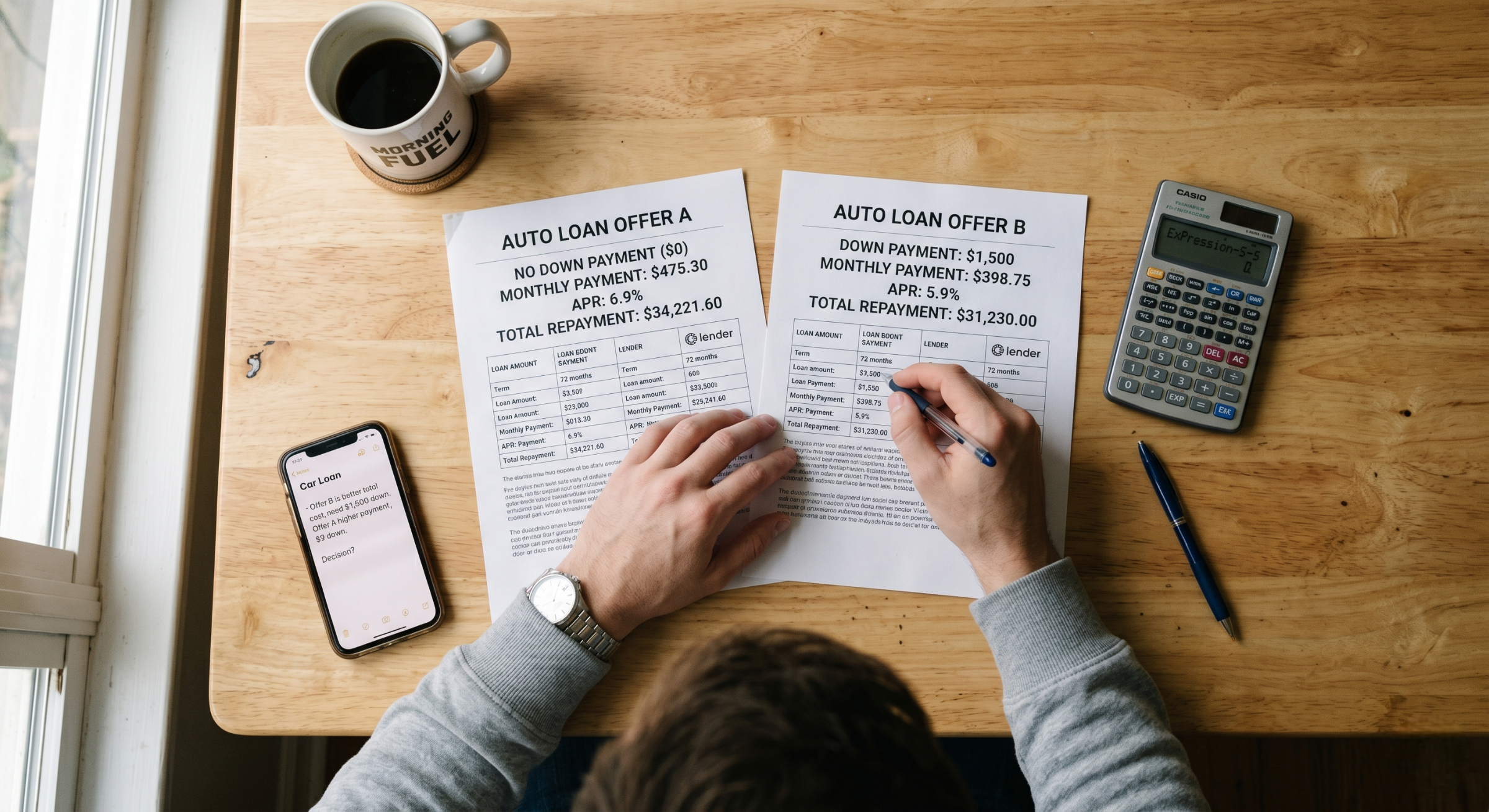
Quick example. Say you’re buying a $20,000 used car at 18% interest over 72 months.
With $2,000 down, you finance $18,000. Your payment is around $410, and you’ll pay roughly $11,500 in interest over the life of the loan.
With nothing down, you finance the full $20,000. Your payment goes up to about $456, and your total interest jumps to around $12,800.
That’s $1,300 more out of your pocket just for the convenience of not putting anything down upfront.
Is it worth it? Depends on your situation. If you don’t have $2,000 sitting around and you need a car right now to get to work, the math still works in your favor. A car you can drive to your job is worth way more than the extra interest you’ll pay. But if you can scrape together even a small down payment, you’ll save money long-term.
What lenders look at when there’s no down payment
When you walk in with zero down, the lender leans harder on everything else about your application. Knowing what they care about helps you put your best foot forward.
Income is the big one. Steady, verifiable, and enough to comfortably cover the payment. Lenders use a payment-to-income ratio, basically how much of your monthly income would go to the car payment. They want to see that number stay reasonable. The lower it is, the more comfortable they get.
Time at work. Six months minimum for most lenders. A year is better. If you’re self-employed, they’ll want to see tax returns or bank statements showing consistent income.
Time at address. Lenders like stability. Someone who’s lived in the same place for two years looks like less of a risk than someone who’s moved three times in the last year, even if everything else is the same.
Recent credit activity. A 580 credit score with no recent missed payments looks better than a 620 score with a missed payment last month. Lenders care a lot about what you’ve been doing recently, not just your historical score.
Bankruptcy history. Discharged is fine for most subprime lenders. Active bankruptcy is harder. If you’re recently discharged, having a few months of clean credit activity since the discharge helps your case.
The vehicle matters too
Not every car works for a zero down loan, even if your application is strong.
Lenders look at the loan-to-value ratio, which is basically the loan amount compared to what the car is actually worth. With nothing down, your loan is automatically higher than the car’s value, so the lender is already stretching. If the car itself is questionable, like high mileage, older than 10 years, or unusual model, they might say no.
The cars that work best for zero down deals are reliable used vehicles in the $10,000 to $20,000 range. Recent enough that the value holds up. Common enough that the lender knows what it’s worth. Reasonable mileage so it’s not going to fall apart before the loan is paid off.
Trying to finance a $5,000 fixer-upper with no money down is harder than financing a clean $15,000 sedan. Sounds backwards, but it’s true. The lender wants the car to be worth something if they have to take it back.
What about scams
Zero down advertising is everywhere, and not all of it is honest. A few things to watch for.
If a dealer promises you can drive away today with no money down, no income check, and no credit check, something’s off. Real lenders verify income. They check credit. If someone’s skipping those steps, they’re either making the loan they offered up out of bad terms hidden in the contract, or they’re going to call you in a week saying the financing fell through and you need to bring in a down payment after all. That’s called a yo-yo deal, and it’s a real thing that happens.
If the rate seems suspiciously low for your credit situation, read the fine print. Some “zero down” offers come with rates that jump up after a few months, balloon payments at the end, or fees that wreck the deal.
The honest version of zero down isn’t magic. It’s a regular subprime loan where the dealer or lender agreed to skip the down payment because the rest of your application was strong enough. The rate will still reflect your credit, the term will be normal, and the contract will be straightforward.
Putting yourself in the best position
If you’re going for a zero down loan and you want to actually get approved, a few things help.
Get pre-approved before you start shopping. Auto loan pre-approval tells you what you qualify for and at what terms before you walk into a dealership. That way you know whether zero down is realistic for you specifically, instead of finding out at the finance desk.
Bring your paperwork. Recent paystubs or bank statements, proof of address, references. Subprime lenders want documentation, and walking in prepared moves the deal faster.
Be honest about your situation. Don’t oversell your income. Don’t hide bankruptcy. The lender is going to find out either way, and getting caught in something inaccurate kills the deal instantly.
Be flexible on the car. The car you want and the car you can get approved on with no money down might not be the same car. Going in willing to look at a few options gives the lender room to find one that works.
Consider a small down payment if you can swing it. Even $500 changes the math significantly and opens up more lenders. If you have to wait an extra month to save up, the better terms usually make it worth it.
When zero down really does make sense
Zero down isn’t the cheapest way to buy a car, but there are situations where it’s the right move.
You need a car right now to keep your job. If your current vehicle just died and you’ve got to get to work Monday, the cost of being without a car for a month while you save up is probably higher than the extra interest you’ll pay.
You have steady income but no savings. Plenty of people have stable jobs but live paycheck to paycheck. Zero down lets you get into a car using your future income instead of waiting to build up cash.
You’re rebuilding credit. Getting into a car loan and making the payments on time builds your credit score. Sometimes the long-term value of starting that rebuild now outweighs the short-term cost of financing the whole thing.
You’ll be refinancing later. If you know your credit is improving and you plan to refinance in 12 to 18 months, the higher rate on the original zero down loan matters less because you’re not going to be paying it for the full term anyway.
The bottom line
Zero down car loans with bad credit are absolutely possible. They’re more expensive than putting money down, but they’re a real option for people who need a car and don’t have cash sitting in savings.
The trick is going in with your eyes open. Know that you’ll pay more in interest. Know that you’ll be underwater for a while. Know that not every lender will say yes, and the ones that do are going to lean hard on your income and stability to make the deal work.
If you’re in a spot where waiting isn’t realistic, zero down can get you on the road and rebuilding your credit at the same time. Just make sure the loan you’re signing is one you can actually afford to keep paying.
How Carfixcredit can help you check your options
Most people who want to know if they can get a zero down loan with bad credit end up Googling around for hours and still not getting a real answer. The reason is simple. The answer depends on your specific situation, and no general article can tell you what a lender will actually approve you for.
Carfixcredit works with a network of lenders across the United States who handle exactly this situation every day. Bad credit, no down payment, past bankruptcies, limited credit history. None of those are automatic disqualifiers here. The options available are usually broader than people expect, and the only way to know what you actually qualify for is to check.
Getting pre-approved takes about two minutes, doesn’t affect your credit score, and gives you a real answer instead of a maybe. No sales calls, no commitment, just clarity on what’s actually available to you.
If you’re tired of guessing whether zero down is realistic for your situation, that’s the next step.