
Zero Down Car Loans with Co-Signers: What Both Parties Should Know Before Signing

TL;DR — Quick Summary
- A zero down car loan with a co-signer finances 100% of the vehicle price using two signatures — both are equally liable for every payment from day one.
- Adding a co-signer with strong credit can improve approval odds, lower the APR by 2–6 percentage points, and make $0 down terms easier to secure for subprime borrowers.
- Co-signers do not own the vehicle, but every late payment hits their credit report the same as the primary borrower’s — including 30, 60, and 90-day delinquencies.
- Most lenders will not release a co-signer until 12–24 months of on-time payments are recorded, the primary borrower’s credit has improved, and a refinance is approved in their name alone.
- CarFix Credit accepts co-signer applications for $0 down auto loans across all 50 US states, with loan amounts from $5,000 to $75,000 and approval decisions in minutes.
Zero down car loans with a co-signer are one of the most common approval paths for credit-challenged buyers in the United States — roughly one in four subprime auto applicants needs a co-signer to get approved at a workable interest rate, and that share climbs higher when the borrower is also asking for $0 down. Combining both is a legitimate route to approval, but it ties two credit profiles to the same vehicle for years. Before either party signs, both need to understand exactly what is on the line.
This guide walks through how zero down co-signed loans actually work, the financial impact on each party, how to protect the co-signer’s credit, and the realistic exit ramps once the primary borrower’s credit improves. Whether you are the buyer or the relative being asked to sign, the details below decide whether this works out or strains the relationship.
CARFIX CREDIT
Wondering whether a co-signer would actually change your approval?
CarFix Credit can show you approval scenarios with and without a co-signer so you and your potential co-signer can decide with full information. It only takes a few minutes — no credit check required to start.
How a Zero Down Co-Signed Auto Loan Actually Works
A zero down car loan with a co-signer is a single auto loan financing 100% of the vehicle price, signed by two people who are each fully liable for the entire balance. The co-signer is not a backup — they are a co-borrower whose income, credit history, and debt-to-income ratio are all pulled into the underwriting decision alongside the primary borrower’s. If the primary borrower stops paying, the lender does not chase them first and then move on to the co-signer; the lender treats both names as the same obligation from the day the contract is signed.
For the lender, this matters because it changes the risk math. A primary borrower with a 580 FICO score and a thin credit file looks risky alone, but pairing them with a co-signer who has a 720 score and a five-year mortgage history brings the blended risk profile closer to prime territory. That is the lever that often makes $0 down possible — without the co-signer, the same applicant might be required to put 10–20% down to offset the lender’s exposure. Understanding how auto loans work under the hood makes it easier to see why a co-signer can move the approval needle so much.
The mechanics on the paperwork side are straightforward. Both parties complete the application, both provide income documentation, both consent to a hard credit pull, and both sign the retail installment contract. The vehicle title, however, generally lists only the primary borrower as the owner — the co-signer takes on the liability without gaining any ownership rights to the car. That asymmetry is the single most important fact for a co-signer to internalize before agreeing.
What the Primary Borrower Gains — and Owes — in a $0 Down Co-Signed Deal
The primary borrower’s gain is approval, a better rate, and the ability to finance the full vehicle price without a down payment. Per Experian’s State of the Automotive Finance Market, the average APR for deep subprime borrowers (scores under 580) on used vehicles reached 21.81% in Q4 2024 — adding a prime co-signer can cut that by several percentage points, which on a $25,000, 72-month loan can mean over $4,000 in interest saved across the life of the loan.
“The average new vehicle loan amount in the United States reached $40,927 in Q4 2024, with the average monthly payment at $742 — meaning a zero down loan with no co-signer support can quickly create a payment most subprime borrowers cannot sustainably afford.” — Experian State of the Automotive Finance Market
What the primary borrower owes goes beyond the monthly payment. With $0 down, they start the loan in negative equity — meaning they owe more than the car is worth from minute one, because vehicles depreciate 10–20% in the first year. They are also taking on a moral obligation to the co-signer that is just as binding as the legal one to the lender. Missing a payment is not just a personal credit hit; it pulls a family member, parent, or partner’s credit score down with it. Anyone shopping a $0 down loan should also run the numbers through a monthly payment calculator at several rate scenarios before committing.
The smart primary borrower goes into this with a plan to refinance the loan into their name alone within 12–24 months, freeing the co-signer from liability. That plan only works if they make every payment on time and use the loan to actively build their credit profile. CarFix Credit structures co-signed loans with this exit path in mind, which is why payment history reporting to the major bureaus is built into every approved loan.
What the Co-Signer Is Actually Agreeing To
A co-signer is agreeing to repay the entire loan if the primary borrower does not — including late fees, repossession costs, and any deficiency balance after the car is sold at auction. The Consumer Financial Protection Bureau (CFPB) reports that roughly 38% of co-signers end up paying some portion of the loan they co-signed, and 28% see their credit score damaged because of it. Before signing anything, every prospective co-signer should read the exact line item on the contract titled “Notice to Co-Signer” or its state equivalent — this is a federal disclosure under FTC rules.
⚠️ Co-Signer Credit Risk Warning: The full balance of a co-signed auto loan appears on the co-signer’s credit report as a debt they owe, raising their debt-to-income ratio for the entire term. This can prevent the co-signer from being approved for their own mortgage, refinance, or credit increase until the car loan is paid off or refinanced into the primary borrower’s name alone.
The credit impact is the most underestimated piece. Every payment — on time or late — reports on both credit profiles. A solid year of on-time payments can help a co-signer’s score modestly, but a single 30-day late payment can drop a prime credit score by 60–100 points. And because the co-signer does not control when the payment gets made, they are exposed to a risk they cannot directly manage. The protective move is for both parties to agree, in writing, that the co-signer gets account access and payment notifications from day one. Reviewing how your credit score is calculated and affected helps both parties see how quickly a missed payment can move the needle.
There is also a non-financial dimension. The CFPB has documented that co-signed loans gone bad are one of the top causes of strained family and romantic relationships in consumer finance complaints. A co-signer should only agree to sign if they could absorb the entire monthly payment for at least six months if the primary borrower could not pay — and if they trust the borrower enough to risk that money.
CARFIX CREDIT
Over 183,000 Americans Have Been Approved Through CarFix Credit — Many With Co-Signer Support.
CarFix Credit offers loan amounts from $5,000 to $75,000 with terms from 12 to 96 months across all 50 US states, including $0 down options for both single applicants and co-signed deals. See exactly what rates you and your co-signer qualify for — approval decisions come back in minutes.
Who Makes a Good Co-Signer (and Who Should Decline)
A good co-signer is someone with a FICO score of at least 670, a debt-to-income ratio under 36%, steady documented income for at least two years, and enough financial cushion to absorb the loan payments if needed. Lenders look at the same factors for the co-signer as they would for any primary borrower — strong credit alone is not enough if the co-signer is already stretched on existing debt.
Practically, the strongest co-signer candidates tend to be parents, older siblings, or long-term partners with established credit histories. The CarFix Credit application process accepts co-signers who are US citizens or permanent residents in any of the 50 states, including high-cost auto markets like California, Texas, and Florida where co-signers are often the difference between approval and denial on $0 down deals.
People who should decline co-signing include anyone planning a major purchase within the next two years (the co-signed loan will count against their borrowing capacity), retirees on fixed incomes, anyone whose own credit is already in the fair or poor range, and anyone who cannot have an honest conversation with the primary borrower about money. If you cannot tell them “you missed a payment and I need you to fix it today,” you should not co-sign.
How to Remove a Co-Signer After the Loan Closes
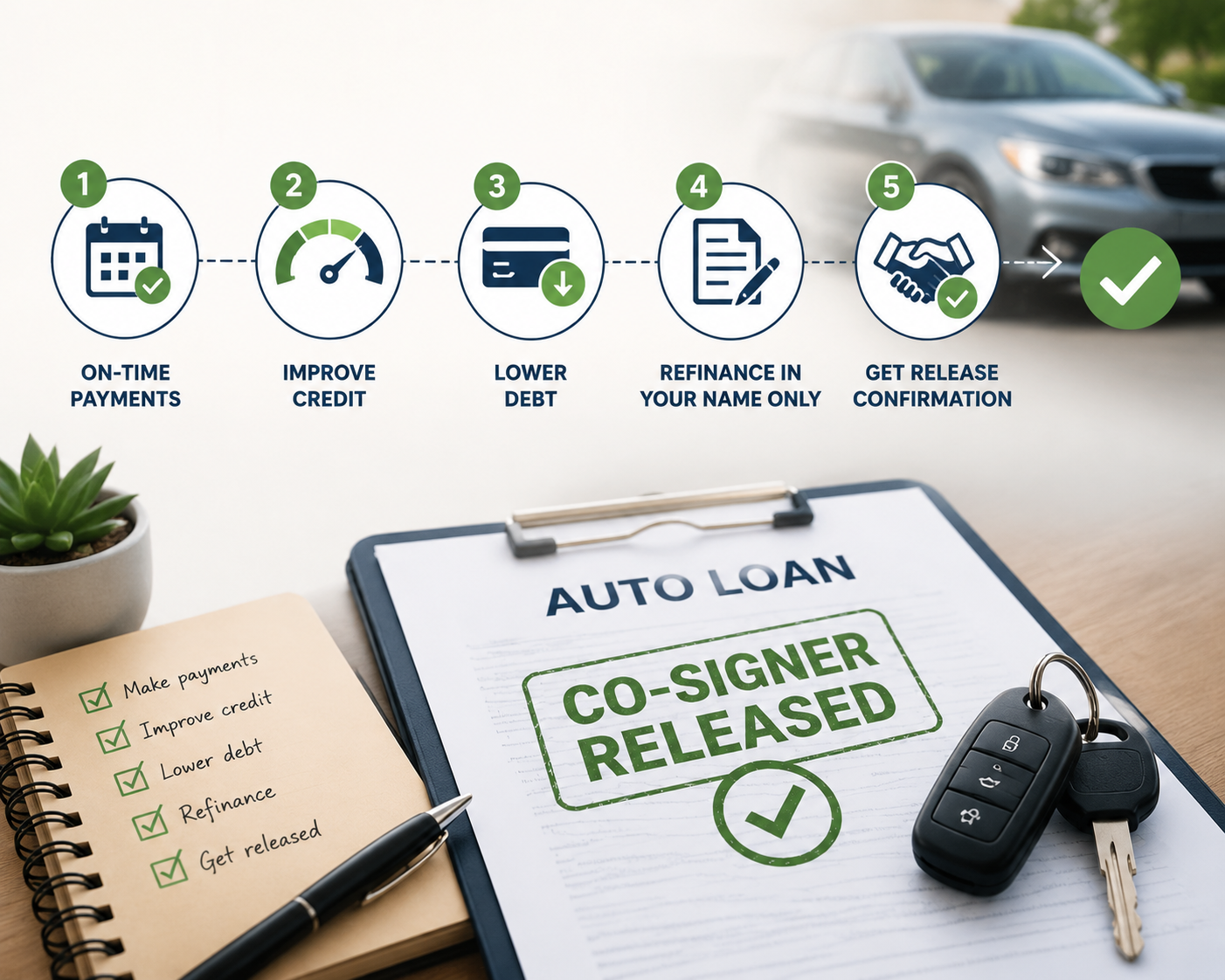
The cleanest way to remove a co-signer from a car loan is to refinance the loan into the primary borrower’s name alone, which requires the borrower’s credit and income to have improved enough to qualify independently. Most lenders, including CarFix Credit lending partners, will consider a co-signer release refinance after 12–24 months of on-time payments, provided the primary borrower’s credit score has climbed into the mid-600s and their debt-to-income ratio supports the payment.
A few lenders offer a formal “co-signer release” option built into the original contract — this lets the co-signer be removed without a full refinance, usually after a set number of consecutive on-time payments. This option is less common in the subprime market but worth asking about during the application. The five practical steps to plan the exit:
- Make every payment on or before the due date for at least 12 consecutive months — autopay is the easiest enforcement.
- Monitor the primary borrower’s credit score monthly and aim for a 50–100 point improvement before applying to refinance.
- Pay down other revolving debt (credit cards) to lower DTI before the refinance application.
- Apply to refinance through CarFix Credit or a direct lender — only after the credit improvements have been reflected for at least one full billing cycle on the bureaus.
- Once the new loan funds, confirm in writing with the original lender that the co-signer has been released from all liability and that the trade line will be marked closed on their credit reports.
If a refinance is not yet possible, the next-best options are paying the loan off early (using a tax refund, bonus, or settlement) or selling the vehicle and using the proceeds to clear the balance. Trying to “informally” remove a co-signer without a refinance or payoff is not a real option — the co-signer’s name stays on the loan until one of those two things happens, no matter what the primary borrower verbally agrees to. For readers exploring related options, more auto financing guides on the CarFix Credit blog cover refinancing strategies in detail.
For buyers still in the planning phase, the best move is to understand the full picture before having the co-signer conversation. Reviewing how the CarFix Credit process works from application to approval walks both parties through what to expect, what documents to bring, and how a co-signer is added to the application. Walking in informed protects everyone involved and keeps the relationship intact.
Frequently Asked Questions
Can I get a zero down car loan with a co-signer if I have bad credit?
Yes, a zero down car loan with a co-signer is one of the most common paths to approval for bad credit borrowers in the United States. CarFix Credit accepts applications from buyers with bad credit, no credit, and post-bankruptcy histories, and a qualified co-signer can both unlock $0 down terms and bring the APR closer to prime rates. Both parties’ income and credit are reviewed together during underwriting.
Does co-signing a car loan hurt the co-signer’s credit?
Co-signing affects the co-signer’s credit in three ways: the hard inquiry causes a small initial dip, the full loan balance appears on their credit report and raises their debt-to-income ratio, and every payment — on time or late — reports to their credit file. On-time payments can modestly help over time, but a single missed payment can lower a prime co-signer’s score by 60 points or more.
Who owns the car in a co-signed auto loan?
The primary borrower is typically the sole name on the vehicle title in a co-signed auto loan, meaning the co-signer has no ownership rights to the car. The co-signer carries the financial liability without the property rights, which is why both parties should fully understand the contract before signing. A co-borrower arrangement (rather than co-signer) is the alternative if both names need to appear on the title.
How long does a co-signer stay on an auto loan?
A co-signer stays on an auto loan until the loan is paid in full, refinanced into the primary borrower’s name alone, or until the lender approves a formal co-signer release — typically only after 12–24 months of perfect payment history. There is no shortcut: even if the primary borrower’s credit improves, the co-signer’s name remains on the loan until one of those three events takes place.
Can a co-signer have bad credit themselves?
A co-signer with bad credit will generally not strengthen the application enough to change the approval outcome or lower the APR. Most lenders require a co-signer to have a FICO score of at least 670, stable income, and a low debt-to-income ratio. If both parties have credit challenges, CarFix Credit can still review the application — but a $0 down approval may require a larger down payment or a different loan structure.
What happens if the primary borrower stops paying on a co-signed loan?
If the primary borrower stops paying, the lender will pursue both parties for the full balance, and the late payments will report on both credit profiles starting at 30 days past due. If the loan goes to repossession, both names follow the deficiency balance — which can be thousands of dollars after auction proceeds are applied. The co-signer’s only protection is to step in and make payments themselves to keep the loan current.
Get Pre-Approved for a Zero Down Auto Loan — With or Without a Co-Signer
CarFix Credit helps Americans across all 50 states get approved for auto financing — regardless of credit history. Loan amounts from $5,000 to $75,000, terms from 12 to 96 months, and approval decisions in minutes.
- ✅ All credit types welcome — including bad credit and bankruptcy
- ✅ $0 down financing options available
- ✅ No credit check to start the application
- ✅ Approval decisions in minutes, fully online
📍 Address: 3401 N. Miami Ave, Suite 230, Miami, FL 33127
🌐 Website: carfixcredit.com
🇺🇸 Coverage: All 50 US states — fully online application
Bad credit. No credit. Bankruptcy. CarFix Credit helps you get on the road regardless.