
Understanding Credit Scores & How They Affect Car Loans

Carfixcredit | Updated April 2026 | 20 min read
Your credit score follows you into every car loan conversation you’ll ever have.
It determines whether you get approved, what rate you’re offered, and ultimately how much the vehicle actually costs you when you factor in everything you’ll pay over the life of the loan. Two buyers purchasing the same car on the same day can end up paying thousands of dollars apart in total interest just because of the difference in their credit scores.
Most people know their credit score matters. Far fewer understand how it actually works, what’s in it, and what they can do to improve it before they apply for financing.
This guide covers all of it. What a credit score is, how it gets calculated, what it means for your car loan specifically, and the practical steps you can take to put yourself in the best possible position before you walk into a dealership.
What Is a Credit Score?
A credit score is a three-digit number that summarizes your credit history. It tells lenders how reliably you’ve handled borrowed money in the past and gives them a quick way to assess the risk of lending to you now.
The most widely used scoring model is the FICO score, which runs on a scale from 300 to 850. Higher is better. A score of 750 and above opens doors. A score below 580 closes some of them, though not all of them.
The VantageScore is another common model used by some lenders. It uses the same 300 to 850 range and draws from similar data. For most practical purposes, the two models produce similar results though they weight factors slightly differently.
When you apply for a car loan, the lender pulls your credit score to help decide whether to approve you and what rate to offer. That single number carries a lot of weight in the conversation.
How a Credit Score Is Calculated
Your score isn’t random. It’s built from specific pieces of information in your credit report, each weighted differently.
Payment history makes up the largest share
This is the single biggest factor in your score. It asks one simple question: do you pay your bills on time?
Late payments, missed payments, and accounts sent to collections all damage this part of your score. A payment that’s 30 days late hurts. One that’s 90 days late hurts more. A collection account or charge-off is more serious still.
On the positive side, a long history of on-time payments across multiple accounts builds this part of your score steadily over time. There’s no shortcut here. It’s built through consistent behavior month after month.
Credit utilization is the second biggest factor
This is the percentage of your available credit that you’re currently using. If you have a credit card with a $5,000 limit and you’re carrying a $4,000 balance, your utilization on that card is 80 percent. That’s high and it hurts your score.
Lenders like to see utilization below 30 percent. The lower the better. High utilization signals that you’re stretched financially, which makes lenders nervous regardless of your payment history.
Paying down balances is one of the fastest ways to move your score because utilization is measured at a specific point in time rather than over a long history.
Length of credit history matters
The longer your credit history, the better. A 10-year-old account in good standing contributes more to your score than a 2-year-old one. This is why financial advisors often tell people not to close old accounts even if they’re not using them. Closing an old account reduces your average account age and can lower your score even if everything else stays the same.
Credit mix plays a smaller role
Having a variety of credit types, credit cards, installment loans, a mortgage, works slightly in your favor. It shows lenders you can manage different kinds of credit responsibly. This factor doesn’t move the needle dramatically but it’s worth being aware of.
New credit inquiries have a short-term effect
Every time you apply for credit, a hard inquiry goes on your report. Each one causes a small, temporary dip in your score. Applying for multiple new accounts in a short period looks like financial stress to lenders and can drag your score down noticeably.
The exception is rate shopping for a specific loan type like a car loan. Credit bureaus generally treat multiple auto loan inquiries within a 14 to 45 day window as a single inquiry, so shopping around doesn’t punish you the way applying for multiple credit cards would.
Credit Score Ranges and What They Mean
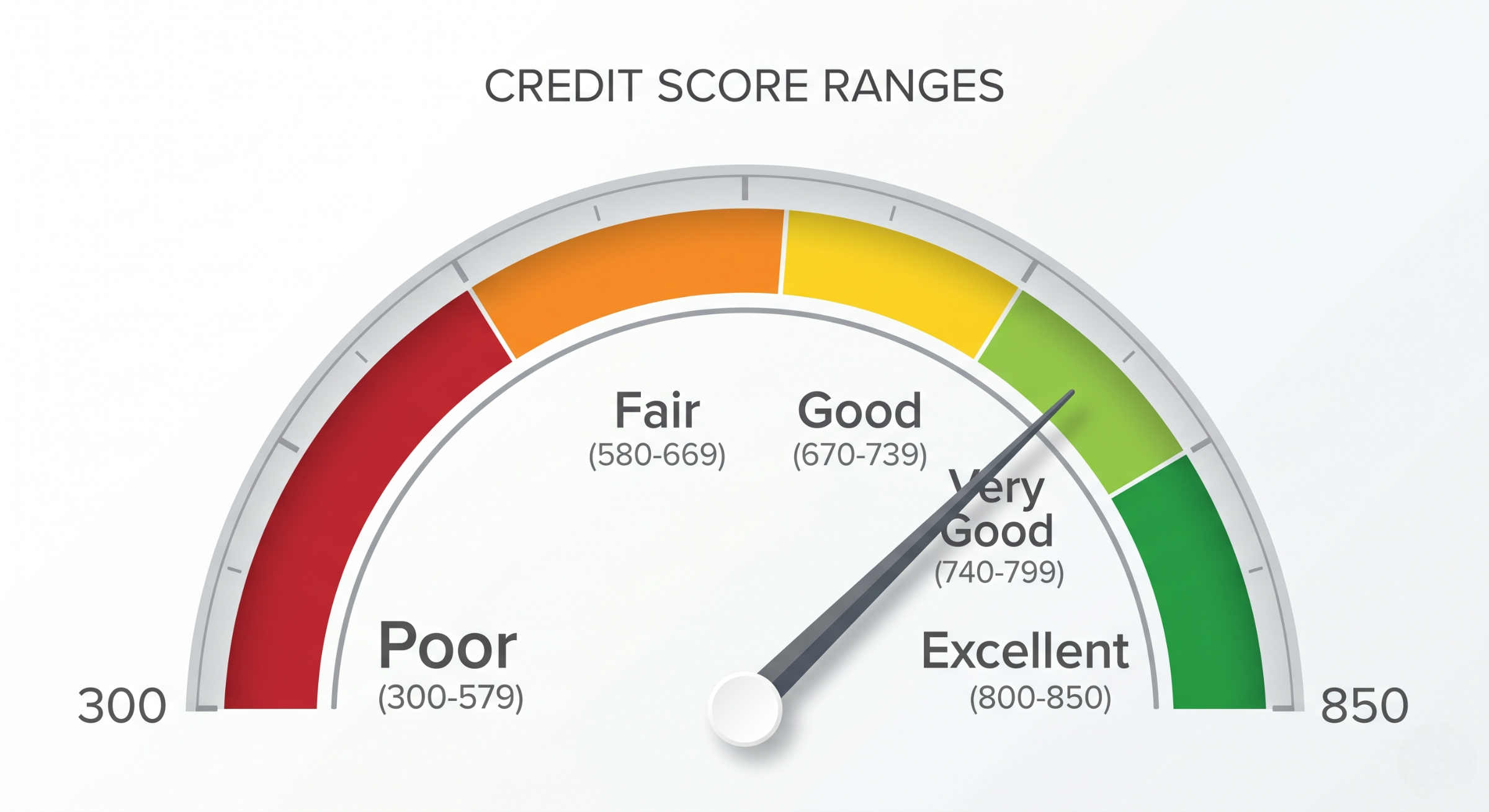
Understanding where your score falls tells you what to expect before you apply.
Exceptional: 800 to 850
The best rates available. Lenders compete for borrowers in this range and the offers reflect that. If your score is here, your only job is to shop around and choose the best offer.
Very Good: 740 to 799
Still in excellent territory. You’ll see competitive rates and have access to a wide range of lenders and loan products. The difference between this range and exceptional is usually small in dollar terms.
Good: 670 to 739
Solid credit. You’ll qualify for most standard auto loans at reasonable rates. Some premium rate offers may be just out of reach but you’re in good shape overall.
Fair: 580 to 669
This is where rates start climbing noticeably. You’re still financeable through many lenders but the cost of borrowing goes up. Shopping across multiple lenders matters more at this level because the variation in offers is wider.
Poor: 500 to 579
Subprime territory. Standard bank financing becomes harder to access. Specialist lenders who work with challenged credit become your primary options. Rates are higher but approval is possible with the right lender. Finding auto loan options with poor credit is more realistic than most people in this range expect.
Very Poor: 300 to 499
The most limited options. Buy here pay here dealerships and specialty subprime lenders are the most accessible routes. A co-signer with strong credit can open additional options. This range is difficult but not hopeless, and it’s important to remember that scores at this level can and do improve with consistent effort.
How Your Credit Score Directly Affects Your Car Loan
The relationship between credit score and auto loan terms is direct and significant. Here’s what it actually looks like in practice.
Interest rate
This is the most immediate impact. A buyer with a score of 780 might get approved at 5.5 percent on a new vehicle. A buyer with a score of 580 might see 17 or 18 percent from a subprime lender on a used vehicle. On a $20,000 loan over 60 months, that difference in rate translates to thousands of dollars in additional interest paid over the life of the loan.
The exact numbers vary by lender, vehicle type, and loan term, but the direction is always the same. Higher score equals lower rate equals less money out of your pocket.
Approval odds
Not every lender approves every buyer. Below certain score thresholds, traditional banks and credit unions become unlikely options. That doesn’t mean no options, but it does mean the pool of lenders willing to work with you narrows.
Loan terms available
Buyers with strong credit have more flexibility on loan structure. They can often choose shorter terms without the monthly payment becoming unmanageable because the rate is low enough to keep the payment reasonable. Subprime buyers are more often pushed toward longer terms to make the payment work, which increases total interest paid.
Down payment requirements
Lenders sometimes require a larger down payment from buyers with lower credit scores to offset the increased risk. This is particularly common on zero or low down payment products. Strong credit buyers have more flexibility on how much they put down upfront.
What’s Actually in Your Credit Report
Your credit score comes from your credit report. Understanding what’s in the report helps you understand how to manage it.
Your credit report contains your personal identifying information, your account history across all credit accounts, your payment history on each account, your current balances and credit limits, public records like bankruptcies, and a record of recent credit inquiries.
The three major credit bureaus, Equifax, Experian, and TransUnion, each maintain their own version of your report. They draw from the same data sources but may have slightly different information depending on which creditors report to which bureaus.
You’re entitled to a free copy of your report from each bureau annually through AnnualCreditReport.com. Pulling your reports and reviewing them carefully is one of the most useful things you can do before applying for any financing.
Errors on Your Credit Report and What to Do About Them
Errors on credit reports are more common than most people realize.
A 2021 study found that a significant percentage of consumers had errors on at least one of their credit reports. Some of those errors were minor. Others were significant enough to affect the score materially.
Common errors include accounts that don’t belong to you, payments incorrectly reported as late, closed accounts showing as open, incorrect balances or credit limits, and duplicate accounts showing the same debt twice.
Any of these can lower your score without reflecting your actual credit behavior. That’s money coming out of your pocket in the form of a higher interest rate on every loan you take out until the error is corrected.
The dispute process is straightforward. Contact the bureau with the error in writing, provide any supporting documentation you have, and the bureau is required to investigate and respond within 30 days. If the error is verified and corrected, your score updates accordingly.
Checking your report for errors before you apply for a car loan is one of the simplest things you can do to potentially improve the rate you’re offered, and it costs nothing.
How to Improve Your Credit Score Before Applying
Improving your credit score takes time but the actions that move it are specific and manageable.
Pay everything on time from this point forward
Payment history is the biggest factor in your score and it’s entirely within your control. Set up autopay for minimum payments on every account so nothing slips through. Even one missed payment can set back months of progress.
Pay down credit card balances
Reducing your utilization ratio has one of the fastest effects on your score of any action you can take. If you can get balances down before you apply for a car loan, your score at application time will reflect the lower utilization.
Don’t open new accounts before applying
New credit inquiries cause small dips and new accounts lower your average account age. Avoid applying for anything new in the months leading up to your car loan application.
Don’t close old accounts
Closing an old credit card removes its credit limit from your available credit, which increases your utilization ratio, and removes its history from your average account age. Both of those changes lower your score. Leave old accounts open even if you’re not using them.
Check for errors and dispute them
As covered above, this is free to do and can have a material impact if there are errors on your report.
Consider a secured credit card if your history is thin
If you have limited credit history, a secured card used responsibly and paid in full each month adds positive payment history and builds your score over time. It’s a slow process but it works.
How Long Does It Take to Improve a Credit Score?
This is one of the most common questions people have and the honest answer is that it depends on what’s dragging the score down.
Reducing utilization can show improvement within a billing cycle or two once the lower balance is reported.
Building payment history is a longer process. A consistent record of on-time payments over 12 to 24 months creates meaningful improvement for most people.
Recovering from a serious negative event like a bankruptcy, foreclosure, or collection account takes longer. These items remain on your report for seven years though their impact on your score diminishes over time, especially as positive history accumulates alongside them.
The key is starting. Every month of clean payment history moves the needle in the right direction. Waiting until your score is perfect before taking action isn’t realistic. Taking action and letting time do its work is.
Credit Scores and Car Loans: Special Situations
Buying with no credit history
First-time buyers with no credit history face a different challenge than buyers with bad credit. There’s no negative information on the report, but there’s also no positive history for lenders to evaluate. Options include first-time buyer programs at credit unions, adding a co-signer with established credit, starting with a modest loan amount to build history, and secured financing products designed for new borrowers.
Buying after bankruptcy
Bankruptcy is a serious negative mark but it doesn’t make auto financing impossible. Many subprime lenders work specifically with post-bankruptcy buyers. You’ll typically need to wait until the bankruptcy is discharged, and rates will be higher, but getting into a vehicle and making consistent payments is one of the most effective ways to start rebuilding after bankruptcy.
Buying with a co-signer
A co-signer with strong credit can dramatically change the terms available to a buyer with challenged credit. The lender evaluates both credit profiles and the stronger one carries significant weight. Both parties need to understand that the co-signer is equally responsible for the loan if payments are missed. That conversation needs to happen honestly and in full before anyone signs.
Rate shopping without hurting your score
As mentioned earlier, multiple auto loan inquiries within a short window are generally treated as a single inquiry by the credit bureaus. Shop across multiple lenders within a 14 to 45 day period and the impact on your score is minimal. This is the right way to find the best available rate without paying a score penalty for doing your homework.
The Relationship Between Credit Score and Total Loan Cost
Most buyers think about their credit score in terms of whether they’ll get approved. The more important question is what the difference in rate actually costs over the life of the loan.
Here’s a practical example using a $25,000 auto loan over 60 months.
At 5.5 percent, the monthly payment is roughly $479 and the total interest paid over the loan is approximately $3,740.
At 12 percent, the monthly payment jumps to roughly $556 and the total interest paid climbs to approximately $8,360.
At 18 percent, the monthly payment reaches approximately $634 and the total interest paid is around $13,040.
That’s a difference of nearly $9,300 in total interest between the best and worst rate scenarios on the same vehicle at the same loan amount. The car costs the same. The financing is what changes everything.
Understanding how your credit score affects your total auto loan cost before you apply is what makes the difference between a buyer who negotiates from a position of knowledge and one who just hopes for the best.
Monitoring Your Credit Score
Staying on top of your credit score is easier than it used to be.
Free credit monitoring is available through most major credit card providers. Apps like Credit Karma and Credit Sesame provide free VantageScore monitoring with regular updates. Many banks now include free FICO score access as a standard account feature.
Monitoring your score has no impact on it. Checking your own credit is a soft inquiry and soft inquiries don’t affect your score regardless of how often you check.
Set up alerts for significant changes so you’re aware of anything that affects your score between now and when you apply for financing. A sudden drop can indicate an error, a missed payment you weren’t aware of, or in some cases, fraudulent activity on your account.
What to Do if Your Score Isn’t Where You Want It
Here’s the honest truth. Plenty of people need a car before their credit is where they’d like it to be. Life doesn’t always wait.
If that’s your situation, the goal is to work with what you have while taking steps to improve it at the same time.
Get into a vehicle through the best financing available to you right now. Make every payment on time. Watch your score improve over the next 12 to 18 months. Then revisit refinancing once your credit has moved into a better range.
That’s not settling. That’s a practical plan that gets you where you need to go, builds your credit in the process, and sets you up for better terms the next time around.
Understanding how to use a car loan to rebuild your credit is one of the more underappreciated pieces of personal finance and it’s something a lot of buyers come out of the process having done successfully.
The Bottom Line
Your credit score is not a permanent verdict on your finances. It’s a snapshot that changes based on your behavior over time.
Understanding what’s in it, what drives it up and down, and how it directly affects what you’ll pay on a car loan puts you in a position that most buyers never reach. Most people walk into financing conversations hoping for the best. The ones who understand their credit walk in knowing where they stand and what to expect.
That knowledge is worth real money. In some cases it’s worth thousands of dollars in interest saved over the life of a loan.
How Carfixcredit Works With All Credit Profiles
Whatever your score looks like right now, there are options worth knowing about.
Carfixcredit connects buyers across the United States with lenders who work with real credit situations. Strong credit, challenged credit, first-time buyers, post-bankruptcy, all of it. The network is built around the full range of credit profiles, not just the straightforward approvals.
The process is simple. You share your situation, it gets matched against lenders set up to work with it, and you find out what’s actually available without a runaround or unnecessary hits to your credit report.
If you’ve been putting this off because you weren’t sure what to expect, finding out for certain is always better than guessing.